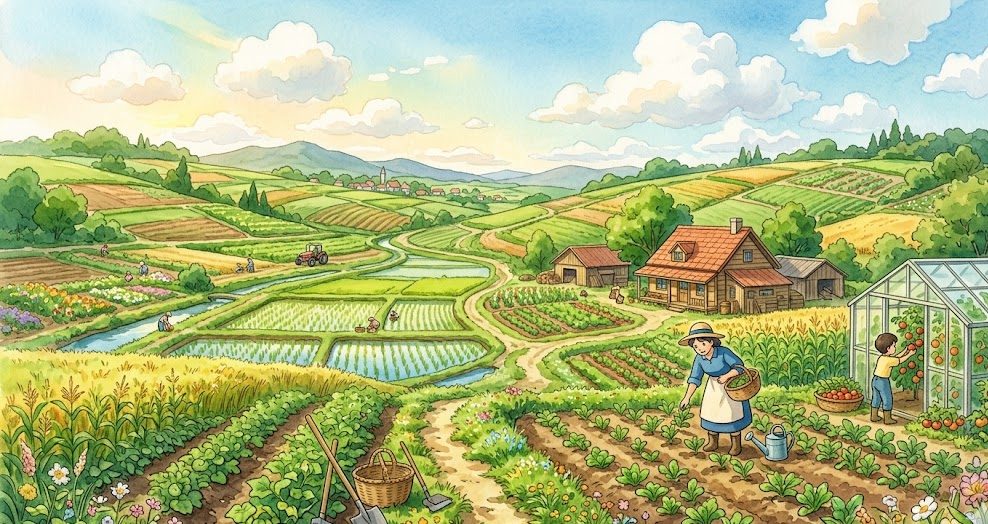
The agricultural industry is facing an unprecedented challenge: maximizing crop yields on a finite amount of arable land while navigating unpredictable climate shifts and rising input costs. For modern agricultural entrepreneurs, agronomists, and farm managers, relying on traditional farming intuition is no longer enough to maintain high profit margins.
To run a highly profitable agribusiness, operators must adopt structured, data-driven frameworks. This comprehensive guide provides actionable crop cultivation blueprints, advanced field management strategies, and proven yield maximization protocols designed to transform standard farming operations into high-yielding, tech-driven enterprises.
1. Structured Crop Cultivation Blueprint
Successful crop production depends on executing the right operational tasks at the exact right biological growth stage. Skipping steps or mismanaging soil preparation directly reduces potential harvest volume.
Phase 1: Advanced Soil and Substrate Conditioning
Before a single seed is planted, the cultivation medium must be optimized to encourage rapid root development.
- Mechanical Soil Aeration: Deep tilling or subsoiling breaks up compacted soil layers, allowing roots to penetrate deeper into the earth to access moisture and vital micronutrients.
- Chemical and Biological Amendments: Conduct a comprehensive soil test to check pH levels. Apply agricultural lime to neutralize overly acidic soils or sulfur for highly alkaline fields. Integrating organic matter or microbial inoculants at this stage improves soil structure and unlocks bound nutrients.
Phase 2: Seed Selection and Precision Sowing
Maximizing yield begins with superior genetics. Always source certified high-yield, disease-resistant seed varieties adapted to your specific regional climate.
- Optimized Planting Density: Overcrowding crops leads to severe competition for sunlight, water, and nutrients, which invites fungal infections. Conversely, planting too sparsely wastes valuable field space. Use precision seed drills to maintain ideal spacing and uniform depth, ensuring synchronous germination across the entire field.
2. Advanced Precision Field Management
Once crops are established, field management shifts from preparation to rigorous monitoring and environment control. Precision agriculture eliminates guesswork by utilizing data to guide day-to-day operations.
[IoT Sensor Telemetry] ➔ [Data Analysis / Diagnostics] ➔ [Variable Rate Application]
Automated Irrigation and Nutrient Delivery
Water stress—whether too much or too little—is a leading cause of crop failure. Modern field management utilizes automated irrigation networks integrated with soil moisture sensors.
- Drip Fertigation: Instead of broadcasting fertilizer manually over the soil, integrate automated dosing pumps into drip irrigation lines. This method delivers a balanced mix of water and liquid nutrients directly to the root zone, reducing water waste by up to 40% and preventing fertilizer runoff.
Integrated Pest and Disease Management (IPM)
A reactive approach to pests and plant diseases often results in heavy crop damage and expensive chemical rescue treatments. An effective IPM strategy focuses on prevention and early intervention:
- Biological Interventions: Deploy beneficial predatory insects to keep pest populations below economic injury levels without harming the crop.
- Early Diagnostics: Routinely scan fields for early signs of leaf chlorosis, stress patterns, or fungal spots to isolate outbreaks before they spread across the entire canopy.
3. Visualizing Modern Crop Cultivation Infrastructure
Understanding how data flows between field sensors, irrigation systems, and the crop canopy is essential for mastering precision field management. The diagram below illustrates a highly optimized, modern cultivation setup.
+--------------------------------------------------------------------------+
|                     PRECISION CULTIVATION ARCHITECTURE                   |
+--------------------------------------------------------------------------+
|                                                                          |
|    [ Sunlight / Weather Data ]   [ Automated Drip Fertigation ]          |
|                 │                               │                        |
|                 ▼                               ▼                        |
|  ┌────────────────────────────────────────────────────────────────────┐  |
|  │                        HIGH-YIELD CROP CANOPY                      │  |
|  └────────────────────────────────────────────────────────────────────┘  |
|                 ▲                               ▲                        |
|                 │                               │                        |
|    [ IoT Soil Moisture Probes ]   [ Real-Time Nutrient Sensors ]         |
|                                                                          |
+--------------------------------------------------------------------------+
| MANAGEMENT LAYER: Automated adjustments based on live soil telemetry    |
+--------------------------------------------------------------------------+
4. Operational Protocols for Yield Maximization
Achieving peak yield requires fine-tuning every aspect of the crop lifecycle, particularly during the critical transition from vegetative growth to the reproductive stage.
Maximizing Photosynthetic Efficiency
The more efficiently a crop canopy captures sunlight, the higher its yield potential.
- Canopy Management: In high-value crop cultivation, strategic pruning and trellising open up the dense plant canopy. This improves airflow, reduces humidity pockets that breed fungus, and ensures lower leaves receive adequate sunlight for photosynthesis.
Micronutrient Timing Strategy
Many growers focus exclusively on Macronutrients (Nitrogen, Phosphorus, and Potassium). However, yield maximization requires precise application of micronutrients like Zinc, Boron, and Magnesium at specific growth stages:
- Pre-Flowering Stage: Applying Boron immediately prior to flowering improves pollen viability and seed set, directly expanding the total number of fruits or grains produced per plant.
5. Strategic Optimization for Maximum Return on Investment
Transitioning to advanced field management systems requires careful planning, but the long-term impact on operational efficiency and profitability is substantial.
| Optimization Pillar | Tactical Field Action | Expected Financial & Yield Benefit |
|---|---|---|
| Precision Sowing | Implement automated seed drilling with calibrated spacing. | Increases germination uniformity, raising baseline yields by 15% to 20%. |
| Targeted Fertigation | Inject liquid nutrients directly through root-zone drip lines. | Cuts total fertilizer costs by 30% while accelerating crop growth cycles. |
| Data-Driven Logging | Track soil moisture, EC, and climate metrics daily. | Minimizes water waste and completely prevents crop loss from unexpected dehydration. |
Export to Sheets
Post-Harvest Management and Logistics
Yield maximization does not conclude when the crop is picked. Up to 20% to 30% of total yield can be lost due to poor post-harvest handling. Implementing immediate sorting, clean storage environments, and temperature-controlled logistics preserves crop quality, maintains weight, and ensures you command premium market prices at final delivery.
By combining structured cultivation guides with disciplined field management and smart resource automation, modern agricultural operations can achieve stable, predictable, and highly profitable harvest yields year after year. Adopting these advanced protocols positions your agribusiness at the cutting edge of modern farming efficiency.