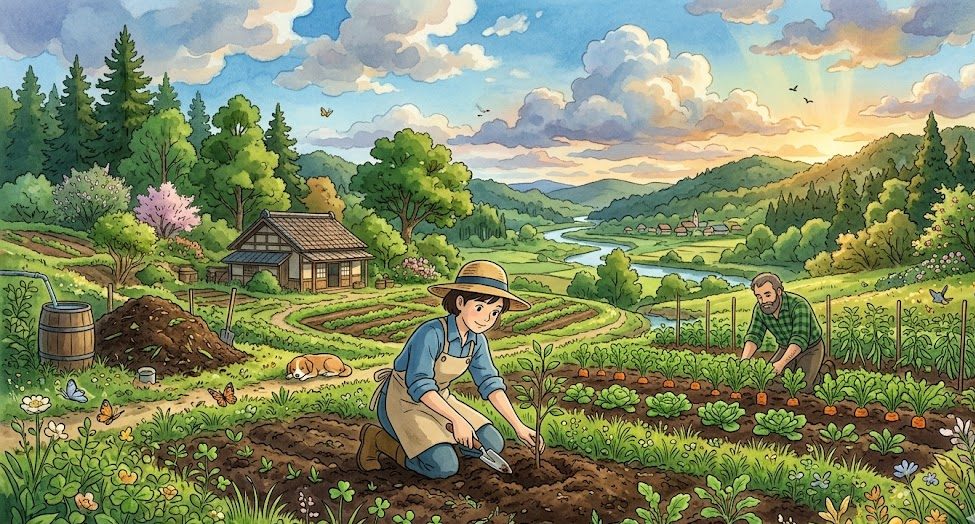
In the face of a rapidly changing climate, soil is no longer just the medium in which we grow our crops—it is our most valuable asset for survival. As weather patterns become more volatile, with unpredictable rainfall, prolonged droughts, and increasing heatwaves, the health of our soil determines whether a farm thrives or fails.
Building “resilient roots” is about transforming the land into a sponge that can hold onto water during dry spells and drain effectively during heavy storms. It is a transition from extractive farming to regenerative stewardship. Here is how small-scale farmers can implement practical, high-impact strategies to improve soil health and secure their future.
1. Minimizing Soil Disturbance
For generations, heavy tilling was considered the standard for preparing a seedbed. However, aggressive tilling shatters the soil structure, destroys the fungal networks (mycelium) that help plants access nutrients, and exposes organic matter to oxidation, which releases carbon into the atmosphere.
- The No-Till or Low-Till Approach: By shifting to no-till or reduced-tillage methods, you allow the soil biology to thrive. Using tools like a broadfork to aerate the soil without turning it over preserves the layers of life underground. This structure creates “macropores”—tunnels left by roots and earthworms—that allow water to penetrate deep into the ground, reducing runoff and erosion.
2. The Power of Constant Cover (Cover Cropping)
Bare soil is a dying ecosystem. When soil is exposed to direct sunlight and heavy rain, it loses moisture, nutrients, and its living structure.
- Living Armor: Implementing cover crops—such as clover, vetch, or rye—during the off-season protects the soil surface. These plants act as “living armor.” Their roots hold the soil in place, preventing erosion, while the biomass they add to the surface keeps the soil temperature cool and suppresses weed growth.
- Green Manure: When these cover crops are terminated and allowed to decompose on the surface (or lightly incorporated), they provide a steady supply of organic matter, which is the primary fuel for soil microbes.
3. Boosting Organic Matter with Compost and Mulch
Soil organic matter (SOM) is the “bank account” of a farm. It holds nutrients and water in the root zone. In a changing climate, every 1% increase in SOM can allow an acre of soil to hold thousands of additional gallons of water.
- Composting: On-farm composting is the most effective way to recycle nutrients. By turning crop residues, animal manure, and organic waste into rich humus, you aren’t just adding nutrients; you are adding life. You are inoculating the soil with beneficial bacteria and fungi that help plants resist diseases.
- Mulching: Applying a thick layer of organic mulch (straw, wood chips, or leaves) around crops acts as an insulation blanket. It drastically reduces evaporation rates, keeps roots cool during heatwaves, and breaks down over time to feed the soil profile.
4. Crop Rotation and Biodiversity
Monoculture—growing the same crop in the same spot year after year—is a recipe for soil depletion. It starves the soil of specific nutrients and encourages the buildup of species-specific pests.
- Diverse Rotations: By rotating families of crops (e.g., following nitrogen-hungry tomatoes with nitrogen-fixing legumes like beans or peas), you naturally manage nutrient cycling.
- Polyculture: Planting multiple crops together or in close proximity mimics natural ecosystems. This complexity makes the farm more resilient; if one crop struggles due to a specific weather event, others may thrive, ensuring that the soil remains covered and protected.
5. Managing Water with Precision
In a climate-stressed world, water management must go beyond just “turning on the tap.”
- Contour Farming and Terracing: If your land has any slope, planting along the contour lines of the land prevents water from gaining speed and washing away precious topsoil. Terracing can turn a hillside into a series of flat, highly productive steps that hold water exactly where it falls.
- Swales and Rain Gardens: Creating shallow, wide depressions (swales) along the contour of your landscape can capture surface runoff during heavy rain events, allowing it to slowly infiltrate the water table rather than causing erosion.
The Biological Connection: Feeding the Microbes
The ultimate goal of all these strategies is to cultivate the Soil Food Web. A teaspoon of healthy soil contains more microorganisms than there are people on Earth. These microbes are the ones that actually make nutrients “bioavailable” to plants.
When you stop using heavy synthetic fertilizers and pesticides—which can be toxic to these organisms—and instead provide them with the organic matter they need, the soil begins to take care of itself. The plants become stronger, more pest-resistant, and better able to survive climate-induced stress.
The Long-Term Return on Investment
Improving soil health is a marathon, not a sprint. The first year of transition can be challenging as the soil biology rebalances itself. However, by year three or four, farmers often report:
- Reduced dependence on expensive external inputs (fertilizers and pesticides).
- Greater crop resilience during drought and flood cycles.
- Higher nutrient density in produce.
Conclusion: Stewardship as Strategy
As we navigate a future defined by climate uncertainty, our approach to farming must shift from “controlling nature” to “working with nature.” Improving soil health is the most practical, cost-effective, and empowering strategy available to small-scale farmers.
By focusing on the roots, we build a legacy. Healthy soil is not just a farm’s foundation; it is a community’s insurance policy against a changing world. When we nurture our roots, we grow more than just food—we grow resilience.