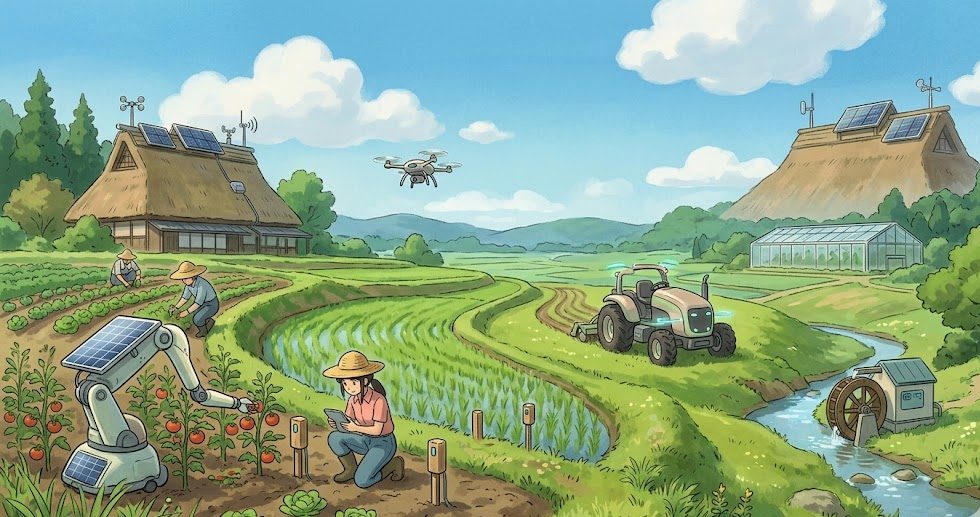
For centuries, farming was a game of intuition, tradition, and unpredictable weather. A farmer would look at the sky, feel the soil, and cross their fingers that nature would cooperate. While these time-tested methods fed generations, the modern world presents entirely new challenges.
By the year 2050, the global population is expected to reach nearly 10 billion people. To feed everyone, global food production needs to increase by roughly 60% to 70%. At the same time, farmers are dealing with shrinking arable land, unpredictable climate shifts, and severe labor shortages.
Enter Smart Farming and Artificial Intelligence (AI).
Agriculture is undergoing a quiet, digital revolution. From autonomous tractors to data-driven crop analytics, technology is changing the face of farming forever. Here is a deep dive into how AI and smart tech are transforming how we grow our food.
1. Precision Agriculture: No More Guesswork
In traditional farming, treatments are applied uniformly. An entire field gets the same amount of water, fertilizer, or pesticide, regardless of whether certain areas need more or less.
Precision agriculture changes all of that. By using AI and the Internet of Things (IoT), farming is shifting from an “all-field” approach to a “per-plant” approach.
- IoT Soil Sensors: Small sensors placed throughout fields monitor soil moisture, temperature, and nutrient levels in real-time. They tell the farmer exactly when a specific section of land needs water or fertilizer.
- Targeted Chemical Application: Instead of spraying a whole field with herbicide, AI-powered sprayers can identify weeds among crops using computer vision and spray only the weed. This reduces chemical use by up to 90%.
By optimizing resources, farmers save money on inputs while drastically reducing the environmental impact of chemical runoff.
2. Eyes in the Sky: Drones and Satellite Imaging
One of the biggest challenges for farmers, especially those with thousands of acres, is monitoring crop health. Walk-through inspections are time-consuming and often miss early signs of trouble.
Today, AI-driven drones and satellites act as a farmer’s eyes in the sky.
How Agricultural Drones Work:
- Multispectral Imaging: Drones don’t just take photos; they use special cameras to capture light bands that the human eye cannot see. Healthy plants reflect light differently than stressed plants.
- Early Warning Systems: AI algorithms analyze these aerial images to detect pest infestations, fungal outbreaks, or nutrient deficiencies days before they become visible on the ground.
- Yield Prediction: By tracking growth rates over time, AI can accurately predict harvest yields, helping farmers plan their logistics and supply chains well in advance.
3. The Rise of Agricultural Robots and Automation
Labor shortages are a massive crisis in global agriculture. Finding enough seasonal workers to harvest crops on time is becoming harder every year, leading to millions of dollars in wasted food.
Robotics and automation, powered by machine learning, are stepping in to fill the gap.
- Autonomous Tractors: Self-driving tractors guided by GPS and AI can plow, seed, and cultivate fields 24/7 without a human driver. They optimize routes to save fuel and prevent soil compaction.
- Robotic Harvesters: Picking delicate fruits like strawberries, apples, or grapes requires a gentle touch. Modern robotic pickers use 3D vision to assess if a fruit is perfectly ripe, pluck it without bruising it, and sort it by size.
- Automated Weeding: Robotic weeders use mechanical blades or laser beams to zap weeds, eliminating the need for manual hoeing or chemical weedkillers.
4. Livestock Management and Smart Barns
AI isn’t just for plants; it is completely transforming animal husbandry as well. “Smart Barns” and wearable tech for livestock are ensuring better animal welfare and higher efficiency.
| Technology | Application | Impact |
| Smart Collars/Ear Tags | Tracks movement, heart rate, and temperature of cattle. | Detects illness early; alerts farmers when a cow goes into labor or heat. |
| AI Facial Recognition | Scans the faces of pigs or cows in a herd. | Tracks individual weight gain, food intake, and behavioral changes. |
| Automated Milking Systems | Robots milk dairy cows whenever the cows feel ready. | Increases milk yield while reducing stress on the animals. |
By catching illnesses early, farmers can isolate sick animals before a disease spreads through the entire herd, minimizing the need for heavy antibiotics.
5. Climate Resilience and Predictive Analytics
Climate change has made traditional weather patterns unreliable. AI excels at processing massive datasets, making it an invaluable tool for climate risk management.
AI-driven predictive analytics software analyzes decades of historical weather data, current atmospheric conditions, and soil trends.
- Optimal Planting Windows: AI can tell a farmer the exact day to plant seeds to maximize survival rates based on upcoming weather patterns.
- Water Management: In drought-prone areas, AI predictive models calculate exactly how much water a crop will need over the next week, allowing farmers to budget water resources carefully.
The Challenges Ahead: Is the Future Accessible?
While the benefits of AI and smart farming are undeniable, the transition isn’t without hurdles.
The Digital Divide: High-tech machinery, sensors, and AI software require a massive upfront financial investment. While large corporate farms can afford this tech, small-scale family farms—especially in developing nations—risk being left behind.
Additionally, many smart devices rely on high-speed internet connectivity, which is notoriously poor in rural farming communities.
To truly change agriculture forever, tech companies and governments must work together to make these tools affordable, rugged, and accessible to smallholders worldwide.
Conclusion: A Greener, Smarter Tomorrow
Smart farming is no longer a concept from a science fiction movie; it is a living reality happening right now in fields across the globe.
By combining the timeless wisdom of traditional farming with the analytical power of Artificial Intelligence, agriculture is becoming highly efficient, sustainable, and resilient. This technology doesn’t just help farmers increase their profits—it ensures that our global food systems can survive the challenges of the future.