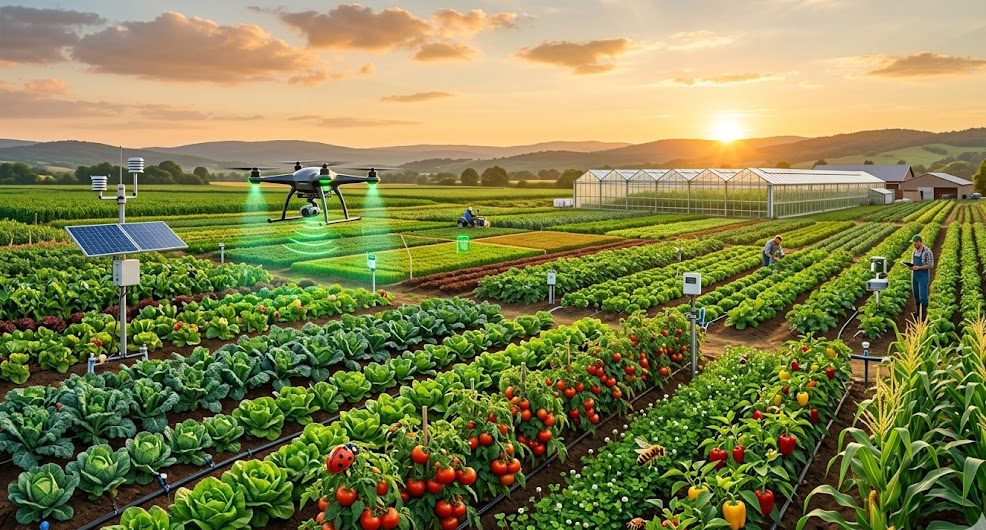
Farming has never been for the faint of heart, but today’s agricultural landscape is facing a unique set of intersecting pressures. Between unpredictable climate shifts, rising input costs, and the urgent need for global food security, traditional agronomy is rapidly evolving. The days of relying solely on historical intuition and generalized almanacs are behind us. To remain profitable, the modern farmer must transition from simply maximizing physical output to optimizing resilience, efficiency, and sustainability.
IJOEAR
Whether you are managing a large-scale commercial operation or a specialized mid-sized farm, achieving record-breaking harvests requires a structured approach. A comprehensive crop guide is no longer just a static planting schedule; it is a data-driven roadmap that integrates soil health, precision technology, and resource management. In this guide, we will break down the essential strategies and smart farming techniques you need to maximize your farm yield and secure your agricultural operations for the future.
The Shift Toward Precision and Smart Farming
The global agriculture industry is undergoing a massive digital transformation. As of 2026, the global precision farming market has surged past the $16 billion mark, driven largely by the integration of artificial intelligence, IoT (Internet of Things) devices, and advanced data analytics. This is not just a trend reserved for massive corporate agribusinesses; this technology has scaled down, making it highly accessible and essential for operations of all sizes.
The core philosophy of this shift is simple: treat every square meter of your field uniquely rather than applying a blanket strategy across the entire farm. Precision agriculture allows for site-specific management. By utilizing remote sensing and variable rate technology (VRT), you can pinpoint exactly which areas of your land need more water, less fertilizer, or immediate pest intervention. This level of granular control dramatically reduces input costs while simultaneously pushing crop yields to their absolute genetic potential.
The Core Pillars of a High-Yield Crop Plan
Building a robust crop guide requires focusing on the foundational elements of plant growth while applying modern innovations to enhance them. Here are the core pillars that should anchor your daily farming operations.
1. Regenerative Soil Management
Healthy soil is the biological engine of your entire farm. Without an active, nutrient-dense soil microbiome, even the most advanced seeds will fail to thrive. The industry is seeing a major shift toward “Nature Positive Agriculture,” which prioritizes long-term soil equity and ecosystem health over short-term chemical stimulation.
To maximize yield, your crop guide must include regular, grid-based soil testing. Stop guessing your pH and NPK (Nitrogen, Phosphorus, Potassium) levels. Use modern soil sensors to monitor moisture and nutrient density in real-time. Combine this data with regenerative practices like no-till farming and the strategic use of cover crops. These practices prevent topsoil erosion, improve water retention, and naturally suppress weeds, leading to a much more resilient primary cash crop.
2. Precision Irrigation and Water Efficiency
Agriculture remains the world’s largest consumer of freshwater, making water scarcity a growing operational risk for farmers globally. Applying the exact amount of water a crop needs—no more, no less—is critical for maximizing yield and protecting your operating margins.
Upgrade your crop management plan by moving away from traditional, wasteful flood irrigation. Automated, sensor-based irrigation controllers are now the industry standard. By placing moisture sensors at varying root depths, your system can trigger watering cycles only when the plant is actively experiencing a deficit. This prevents waterlogging, reduces nutrient runoff, and forces the crop to develop deeper, stronger root systems that can survive unexpected dry spells.
3. Advanced Seed Selection and Bioengineering
The seeds you choose dictate the absolute upper limit of your yield potential. Recent breakthroughs in bioengineering and gene-editing have produced crop varieties with incredible trait stacking. Today’s commercial seeds offer unprecedented drought tolerance, enhanced pest resistance, and improved structural integrity to prevent lodging (stalk breakage) during high winds.
When developing your seasonal crop guide, spend adequate time researching the specific cultivars that perform best in your exact micro-climate. Do not simply buy what worked a decade ago. Leverage local agricultural extension data to select seeds bred specifically for the environmental challenges your region faces today.
Developing Your Seasonal Farm Action Plan
A comprehensive crop guide is executed in distinct phases. Here is how to structure your farm management workflow from pre-planting all the way to post-harvest.
Pre-Planting: Field Mapping and Predictive Analytics
Before a single seed goes into the ground, you should be utilizing predictive diagnostics. Use farm management software to map your field boundaries and identify historical trouble spots. If a specific acre consistently underperforms year after year, use GPS-guided soil sampling to find out exactly why.
This is also the crucial time to run yield forecasting models. By analyzing local weather predictions, historical yield data, and current soil moisture levels, you can make highly informed decisions about optimal planting dates, seed density, and planting depth.
Mid-Season: Crop Scouting and Real-Time Adjustments
Once the crop has emerged, your focus immediately shifts to protection and optimization. Manual crop scouting is incredibly time-consuming and often misses early signs of plant stress.
Instead, integrate drone technology and crop health monitoring into your weekly workflow. UAVs equipped with multispectral cameras can fly over hundreds of acres in minutes, identifying nutrient deficiencies, irrigation leaks, or localized pest infestations long before they are visible to the naked eye. Once a problem area is identified, you can deploy targeted treatments using variable rate technology, spraying only the affected zones rather than wasting expensive chemicals on perfectly healthy plants.
Harvesting: Data Collection and Yield Monitoring
The harvest is not just the end of the current season; it is the primary data collection phase for next year’s crop guide. Modern combine harvesters and picking equipment are outfitted with sophisticated yield monitors. These devices generate highly detailed yield maps, showing you exactly how many bushels or tonnes were pulled from every specific section of the field.
Compare your final yield map against your initial soil and irrigation maps. This cross-referencing highlights exactly which of your interventions worked, which failed, and where your crop management plan needs adjustment for the following year.
Economics and Maximizing Farm Profitability
It is a harsh reality of modern farming that higher yields do not automatically equate to higher profits. The agroindustry frequently experiences economic volatility, with fluctuating input prices for diesel, synthetic fertilizers, and labor heavily impacting the bottom line.
To truly maximize your farm’s financial success, your crop guide must function as a working economic ledger. The adoption of smart farming technologies is fundamentally about input optimization. When you reduce your fertilizer use by 15% through precision application and cut your water pumping costs by 20% through smart irrigation, those savings go directly into your profit margin.
Additionally, farm automation is becoming the most effective way to combat severe labor shortages and rising wage costs. From autonomous tractors utilizing autosteering systems to automated climate controls in indoor farming setups, technology is stepping in to handle repetitive tasks. This allows you, the farm manager, to focus your energy on high-level strategy, forward contracting, and operational growth.
Summary
Maximizing your farm yield requires a decisive step away from outdated methods and a full embrace of data-driven agriculture. By building a comprehensive crop guide that incorporates precision soil testing, targeted automated irrigation, advanced seed genetics, and continuous digital monitoring, you effectively remove the guesswork from farming.
The future of agriculture belongs to those who adapt. Integrating these smart farming technologies will not only boost your physical output per acre but will also build a resilient, environmentally sustainable, and highly profitable farming operation for generations to come. If you are new to digital agronomy, start small by integrating a farm management app or basic soil moisture sensors this season, and progressively scale your technology stack as you see the return on your investment.