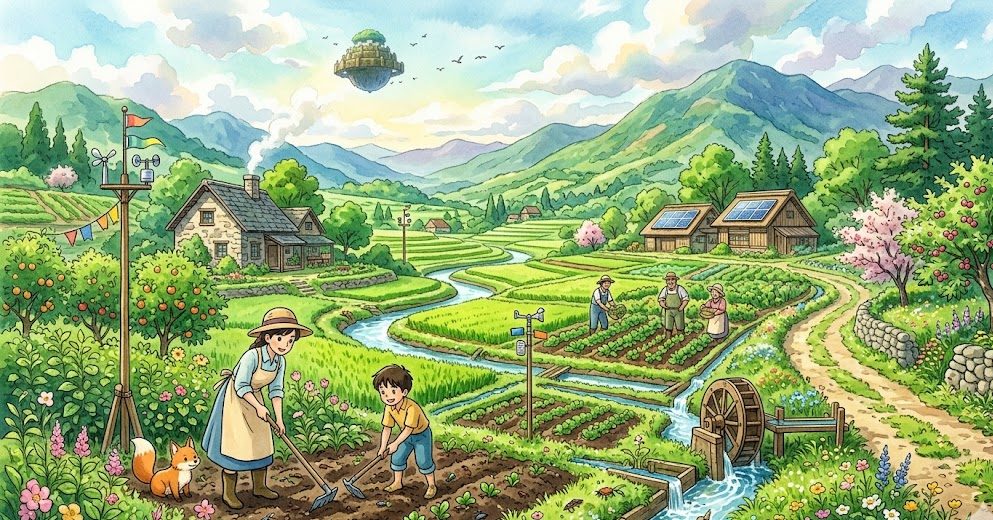
In the agricultural landscape of 2026, the traditional methods of “guessing and hoping” are no longer viable. With global weather patterns becoming increasingly unpredictable and soil health declining due to decades of intensive chemical use, a new discipline has emerged: Smart Climate & Soil Management. This integrated approach leverages Internet of Things (IoT), Artificial Intelligence (AI), and regenerative soil science to create a resilient farming ecosystem. The goal is simple yet profound: to optimize every drop of water and every gram of nutrient to achieve maximum yield while protecting the planet’s most precious resources.
1. The Synergy Between Climate and Soil
Soil and climate are not independent variables; they are deeply interconnected. Climate determines the rate of soil organic matter decomposition, while soil health dictates how well a farm can withstand climate extremes.
A “Smart” approach recognizes that a healthy soil structure acts as a climate buffer. For every 1% increase in soil organic matter, the land can hold an additional 20,000 gallons of water per acre. This makes the farm resilient to both droughts and flash floods.
2. Real-Time Climate Monitoring: Data Over Intuition
In 2026, the most successful farms operate like data centers. High-resolution, hyper-local weather forecasting has replaced general regional reports.
- Micro-Climate Sensors: By placing sensors at various points across the field, farmers can monitor temperature, humidity, and wind speed at the “canopy level.” This is crucial because the temperature at the plant level can be 5°C different from the air temperature recorded at a central station.
- Predictive Modeling: AI algorithms analyze historical weather data alongside current atmospheric conditions to predict “pest outbreaks” or “frost windows” up to 10 days in advance. This allows for Preemptive Protection—applying natural coatings or adjusting irrigation before the damage occurs.
3. Precision Soil Management: The “Deep Tech” of the Earth
Soil management has evolved from bulk fertilization to Variable Rate Application (VRA). Smart soil management treats the field not as a single block, but as a mosaic of different zones with unique needs.
A. Sub-Surface Sensing
Buried IoT sensors provide a 24/7 pulse of the underground environment. These devices measure:
- Volumetric Water Content (VWC): Knowing exactly how much water is in the root zone prevents over-irrigation and leaching.
- Electrical Conductivity (EC): This measures soil salinity and nutrient availability, helping farmers decide exactly when and where to apply fertilizers.
- pH Levels: Maintaining the correct pH is essential for nutrient uptake. Smart systems can automate the application of lime or gypsum to stabilize these levels.
B. The Microbial Revolution
Smart management focuses on the Soil Microbiome. In 2026, we utilize “Biological Data” to understand the population of fungi, bacteria, and protozoa in the soil. Instead of adding more nitrogen (which can be lost to the atmosphere), farmers use bio-stimulants to “unlock” the nitrogen already present in the air and soil.
4. Resource Optimization Strategies for Maximum ROI
Optimizing resources is about achieving Efficiency Ratios. The most profitable farms focus on reducing the “Cost per Unit of Yield.”
- Automated Precision Irrigation: By linking soil moisture sensors to automated valves, the system only waters the plants when the “Root Stress Threshold” is met. This can save up to 50% of water compared to traditional flood or timed irrigation.
- Carbon Sequestration Credits: Smart soil management allows farmers to track how much carbon they are “storing” in the ground. In 2026, this carbon can be sold as “credits” to industrial companies, providing an extra stream of passive income.
- Targeted Fertigation: Delivering nutrients directly through the irrigation system (fertigation) ensures that fertilizers reach the roots immediately, preventing runoff and protecting local groundwater.
5. Overcoming the “Resource Gap” in 2026
The transition to smart management requires overcoming the initial “Digital Divide.”
- Hardware Modularity: Modern systems are becoming more affordable through modular designs. A farmer can start with one soil sensor and one weather station, scaling the network as the revenue increases.
- Satellite Imagery: For larger farms, satellite-based NDVI (Normalized Difference Vegetation Index) maps provide a “hidden” view of plant health, identifying stressed areas long before they become visible to the human eye.
6. Sustainable Yield: The Long-Term Perspective
The ultimate metric of Smart Climate & Soil Management is Sustainability. Chemical-heavy farming provides a short-term spike in yield but leaves the soil “dead” within a decade. Smart management focuses on “Regenerative Yield”—where the soil becomes more fertile with each passing year.
By balancing the chemical, physical, and biological properties of the soil with the realities of the changing climate, farmers can ensure food security for the next generation.
Conclusion: The Era of the Intelligent Farm
Smart Climate & Soil Management is the backbone of the 2026 agricultural revolution. It is where ancient wisdom meets cutting-edge technology. By treating soil as a living organism and climate as a data point to be managed, we move away from “Extractive Agriculture” toward “Optimized Life.”
For the modern agri-entrepreneur, the message is clear: The more you know about what is happening beneath your feet and in the air above you, the more profitable and resilient your business will be.
Comparison: Traditional vs. Smart Management
| Feature | Traditional Management | Smart Management (2026) |
|---|---|---|
| Data Source | Visual Observation | Real-time IoT & AI Sensors |
| Watering | Scheduled/Calendar-based | Sensor-triggered (Demand-based) |
| Fertilizer | Uniform Application | Variable Rate Application (VRA) |
| Risk Handling | Reactive (After Damage) | Proactive (Predictive Alerts) |
| Soil Focus | Chemical N-P-K | Biological Microbiome & Carbon |
| Revenue | Crop Sales Only | Crops + Carbon Credits + Data Insights |
Export to Sheets
Pro Tip for Bloggers: Use keywords like “Precision Agriculture ROI,” “Soil Carbon Sequestration 2026,” and “IoT Irrigation Automation” to rank higher in premium AdSense categories.