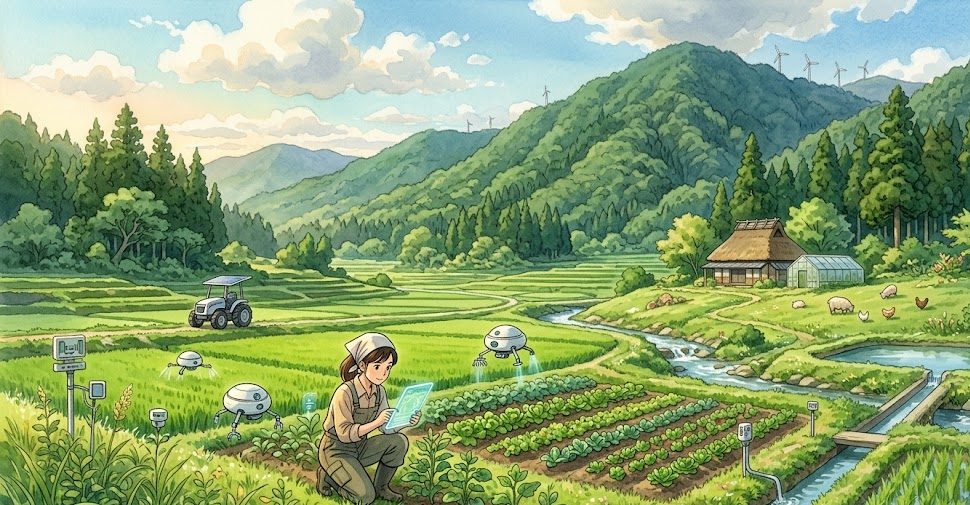
The agricultural industry is undergoing a silent, digital revolution. As the global population grows and climate change makes weather patterns increasingly erratic, the traditional methods of farming are being pushed to their limits. The answer isn’t just “more technology” or “more nature”—it is the intelligent integration of both.
Smart Agriculture (often called Precision Agriculture) leverages the Internet of Things (IoT), AI, and data analytics to work in harmony with biological systems. By combining high-tech monitoring with nature-based regenerative practices, farmers are finding ways to produce more food with fewer resources.
1. The Core of Smart Agriculture: Data-Driven Decisions
At its heart, Smart Agriculture is about reducing uncertainty. Historically, farming was based on intuition—”I think it’s time to irrigate” or “I think this field needs more fertilizer.” AgriTech replaces “I think” with “I know.”
The IoT Network
By placing soil sensors across a field, a farmer can monitor moisture levels, temperature, and nutrient content in real-time. This data is transmitted to a mobile app or central dashboard, allowing for:
- Precision Irrigation: Instead of watering the whole field, systems can trigger micro-irrigation only where moisture levels have dipped below a specific threshold.
- Targeted Nutrient Application: Fertilizer is expensive and harmful if overused. Variable-rate technology applies nutrients only to areas that actually show a deficiency, preventing runoff and lowering costs.
2. Bridging the Gap: Where AgriTech Meets Nature
The most successful modern farms are not “robot-only” facilities; they are hybrid systems. Using technology to support natural ecosystem services is the ultimate goal.
AI-Powered Biodiversity Monitoring
Artificial Intelligence can now analyze drone footage to identify plant health and pest outbreaks before they are visible to the naked eye. Instead of blanketing a crop with synthetic pesticides, a farmer can use this “early warning” to:
- Spot-treat: Apply biological or natural control agents to a 5-meter radius rather than the entire 50-acre farm.
- Encourage Beneficial Predators: Use data to map out optimal “corridors” of native wildflowers that attract pollinators and pest-eating insects (like ladybugs), effectively using nature to do the pest control work.
Precision Weed Management
Robotic weeders, guided by computer vision, can distinguish between a crop and a weed. These machines can remove weeds mechanically, eliminating the need for chemical herbicides. This preserves soil health, allowing microorganisms to flourish—a core tenet of regenerative, nature-based farming.
3. Benefits: Why Efficiency Equals Sustainability
Adopting Smart Agriculture solutions provides a triple-bottom-line benefit: Economic, Environmental, and Social.
| Benefit | How it Works |
| Increased Yields | Optimized growing conditions ensure plants reach their full potential. |
| Reduced Costs | Less water, fuel, and chemical usage leads to higher profit margins. |
| Soil Conservation | Less heavy machinery and fewer chemicals protect long-term soil structure. |
| Climate Resilience | Predictive models help farmers prepare for droughts or floods in advance. |
4. Challenges: Overcoming the Barriers to Entry
While the benefits are clear, the adoption of AgriTech is not without hurdles. For a sustainable transition, farmers must consider:
- Infrastructure & Connectivity: IoT devices rely on stable internet or LoRaWAN networks, which can be challenging in remote rural areas.
- Data Security: As farms become digital, protecting sensitive harvest and soil data from cyber threats becomes vital.
- The “Human” Element: Technology should empower farmers, not replace their knowledge. Training is essential so that tech becomes a tool for better decision-making rather than a complex burden.
5. Future-Proofing: Integrating Regenerative Principles
To truly enhance yields long-term, AgriTech should be used to support regenerative practices. For example:
- Cover Crop Management: Use satellite data to monitor cover crop growth and determine the perfect time to terminate them for maximum soil organic matter integration.
- Rotational Grazing: Use GPS-enabled virtual fencing for livestock. This allows for precision grazing, where cattle act as natural soil builders, moving across the land in a way that mimics wild herd migrations.
Conclusion: The Path Ahead
Smart Agriculture is not about removing the farmer from the field; it is about providing the farmer with “superpowers.” By observing nature through the lens of data, we can move toward a system that is more efficient, more profitable, and deeply sustainable.
Whether you are starting with a simple soil sensor or investing in autonomous drones, the key is to start small. Analyze your biggest pain point—is it water waste? Pest loss? Fertilizer cost?—and find the technological solution that addresses it while respecting the natural biology of your soil.
The future of food isn’t just high-tech; it’s high-wisdom.