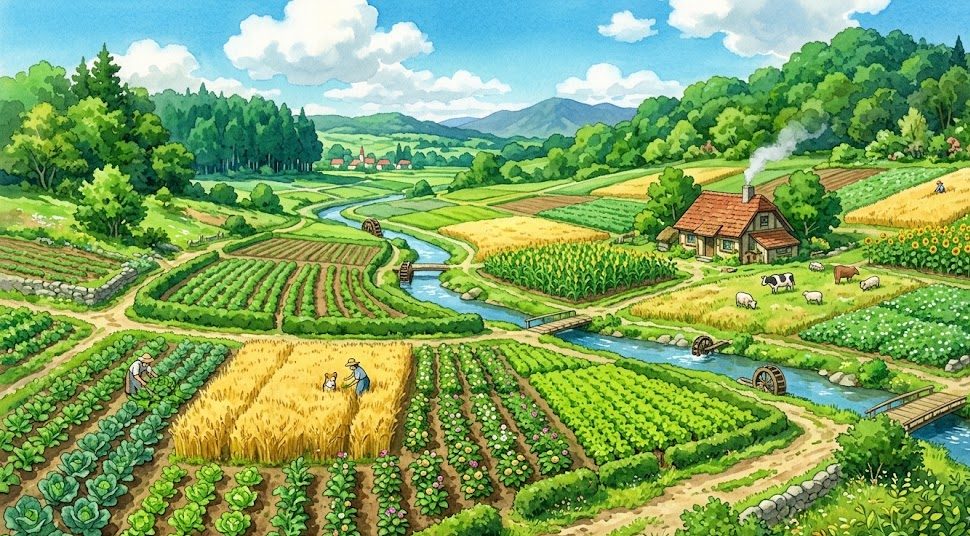
For many small-scale farmers, crop selection often feels like a gamble. Will this year’s market prices favor tomatoes? Should I stick to leafy greens, or is it time to experiment with tubers? While market trends are important, there is a more reliable way to ensure long-term profitability: Strategic Crop Rotation.
Crop rotation is not merely an agronomic practice; it is a financial strategy. By systematically changing the crops grown in a specific field each season, you disrupt pest cycles, manage soil fertility naturally, and spread your financial risk. This “Profitability Blueprint” will help you design a rotation schedule that maximizes your yields and protects your bottom line.
1. The Financial Logic of Rotation
Why do some farmers earn significantly more per acre than others? Often, it comes down to soil health and disease management. When you grow the same crop continuously (monoculture), you create a “buffet” for specific pests and diseases, forcing you to spend money on pesticides. Furthermore, a single crop depletes specific nutrients, forcing you to spend more on fertilizers.
A well-planned rotation:
- Lowers Input Costs: Legumes fix nitrogen, reducing the need for synthetic fertilizers.
- Reduces Risk: If one crop suffers from a weather event or a pest outbreak, your other crops are less likely to be affected.
- Optimizes Yields: Healthy soil results in higher quality produce, which fetches better prices in the market.
2. Categorizing Your Crops
To build a successful rotation, you must categorize your crops based on their needs and their effect on the soil. A simple way to do this is by “Plant Family” and “Nutrient Demand”:
- Heavy Feeders: Crops like tomatoes, peppers, corn, and cabbage require high amounts of nitrogen to produce massive yields.
- Light Feeders: Crops like carrots, beets, and onions are less demanding.
- Soil Builders (Legumes): Peas and beans actually take nitrogen from the air and store it in their roots, naturally enriching the soil for the next crop.
- Soil Conditioners: Root crops with deep taproots (like radishes or daikon) can break up compacted soil, improving drainage for future seasons.
3. The 4-Year Rotation Model
A popular and highly effective model for small-scale farms is the four-year rotation sequence. This ensures that the soil gets a chance to recover before a heavy feeder is planted again.
- Year 1: Heavy Feeders (e.g., Tomatoes or Brassicas): These crops utilize the nitrogen stored in the soil.
- Year 2: Light Feeders (e.g., Root Vegetables): These crops thrive on the residual nutrients left behind and are less prone to the diseases that plagued the Year 1 crops.
- Year 3: Soil Builders (e.g., Legumes): This is your “rest” year. These crops recharge the soil nitrogen levels.
- Year 4: Cover Crop/Green Manure: A dedicated year to add organic matter and suppress weeds, ensuring the cycle resets perfectly for Year 1.
4. Integrating Market Demand
A farm can have the most beautiful soil, but if it produces crops nobody wants to buy, it isn’t profitable. The key to the “Profitability Blueprint” is balancing your agronomic needs with your local market data.
- Analyze Your Sales: Look at which crops sold out fastest last season. These are your “Cash Cows.”
- The 80/20 Rule: Dedicate 80% of your rotation to proven, high-demand cash crops, and use the remaining 20% to rotate in soil-building crops or experimental varieties.
- Succession Planting: Within your rotation, practice succession planting. If your rotation plan dictates a “Heavy Feeder” spot, plant your cash crop in two-week intervals. This ensures a consistent supply for your customers throughout the season rather than one giant, unmanageable harvest.
5. Keeping Records: The Key to Success
Profitability requires data. You cannot optimize what you do not track. Every successful farmer keeps a Field Map and Rotation Log.
- The Map: Create a simple map of your growing beds.
- The Log: At the end of each season, note what was planted, how it performed, and any pest issues you observed.
- Future Planning: Before the next season, review your logs. Did you have a fungal issue with your tomatoes? Move them to a completely different part of the farm for the next three years to break the infection cycle.
6. Overcoming Common Challenges
Farmers often worry that rotation reduces the space available for their most profitable crop. However, view it as an investment. You are not “losing” space; you are investing in the productivity of that soil for the next decade.
If space is extremely limited, consider Intercropping (growing two crops at once, like beans climbing corn stalks). This allows you to combine your rotation needs into a single space, maximizing the revenue potential of every square foot.
Conclusion: Your Long-Term Competitive Advantage
The “Profitability Blueprint” is not just about what you grow today—it is about ensuring that your land remains productive and profitable ten years from now. By rotating crops, you are managing your risks, reducing your dependency on expensive external inputs, and building a farm that is resilient enough to thrive regardless of market fluctuations.
Start small. Even a basic rotation between two or three crop families is better than none. As you get comfortable with the rhythm of your land, expand your rotation to include more diversity. Remember, healthy, rotating soil is the foundation of a healthy, profitable business.