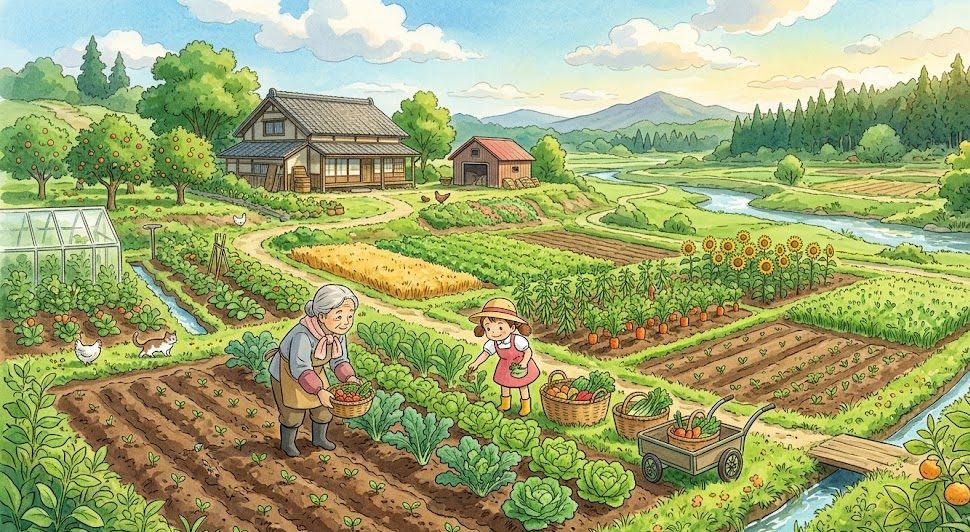
In the world of intensive, small-scale agriculture, crop rotation is not just a gardening suggestion—it is your most powerful financial and operational strategy. By systematically changing which crops you grow in specific plots over time, you break the life cycles of pests, prevent soil exhaustion, and maximize your land’s productive capacity throughout the entire year.
For the modern cultivator, the goal is to keep the soil working and the revenue flowing. Here is your ultimate guide to mastering year-round crop rotation to achieve maximum yield.
1. Why Rotation Matters: The “Yield Killers”
If you plant the same crop (e.g., tomatoes or heavy-feeding greens) in the same spot repeatedly, three things happen:
- Pest and Disease Build-up: Soil-borne pathogens specific to a plant family (like Solanaceae for tomatoes/potatoes) will thrive.
- Nutrient Imbalance: Different crops have different “appetites.” Continual planting of the same crop strips the soil of the same specific micronutrients.
- Soil Structure Degradation: Roots of the same type penetrate the soil to the same depth, leading to compacted zones.
Rotation solves these problems by alternating families, nutrient demands, and root architectures.
2. The Golden Rule: The “Family” System
To rotate effectively, you must categorize your crops into families. Never follow a plant with another member of the same family.
| Family | Key Crops | Nutrient Need |
| Legumes | Peas, Beans | Nitrogen Fixer (Giver) |
| Brassicas | Broccoli, Kale, Cabbage | Heavy Feeder |
| Solanaceae | Tomatoes, Peppers, Potatoes | Heavy Feeder |
| Alliums | Onions, Garlic, Leeks | Light Feeder |
| Roots/Umbellifers | Carrots, Parsnips, Celery | Light Feeder |
3. The 4-Season Planning Strategy
To achieve maximum yield, your farm must never “rest” empty. You need a relay-planting approach that considers both the season and the crop family.
Phase 1: The Spring Heavy-Feeders
Start the year with heavy feeders (Brassicas or Solanaceae). These require the high levels of nitrogen and compost you prepared in the winter.
- Example: Transplanting broccoli or early tomatoes.
Phase 2: The Summer Legume Refresh
As your spring crops finish, it is time to “recharge.” Follow your heavy feeders with legumes.
- Why: Legumes take nitrogen from the air and store it in their roots. When you harvest the peas or beans, the soil is left significantly more fertile for the next round.
Phase 3: The Autumn Light-Feeders
Follow legumes with light-feeding root crops (carrots, beets) or alliums (onions, leeks).
- Strategy: Root crops help break up the soil structure and require less nitrogen, making them the perfect candidates for soil that has just been “refreshed” by legumes.
Phase 4: The Winter Cover
Never leave your beds bare during the winter. If you aren’t growing a winter harvest crop (like spinach or winter kale), plant a cover crop like vetch, clover, or winter rye.
- The Benefit: This prevents erosion, smothers weeds, and when turned into the soil in early spring, it acts as the “base layer” for the next cycle of heavy feeders.
4. Operational Tips for the Modern Farmer
- Map Your Farm: Create a simple map of your beds. Each season, shift your “family blocks” clockwise. If you had tomatoes in Bed A in Spring, move them to Bed B in the next cycle.
- Track Growth Cycles: Use a spreadsheet or app to log the “days-to-maturity” for every crop. This allows you to plan your rotation to the exact week. If you know a crop takes 60 days, you can prep the seedlings for the next rotation to be transplanted the day after harvest.
- Intercropping (The “Turbo-Boost”): Don’t wait for one crop to finish to start another. Plant short-season crops (like radishes) between the rows of longer-season crops (like peppers). By the time the peppers need the space, the radishes are already harvested.
5. Integrating High-Value Niche Crops
If you are farming for profit, you must rotate “Cash Crops” with “Soil Builders.”
- The “Microgreen” Exception: If you are growing microgreens in trays or hydroponic racks, these do not follow traditional field rotation. Use them to fill the “gap” in your revenue streams while your outdoor beds are in their rest or cover-crop phase.
- Vertical Integration: Rotation applies to vertical space too. If you are growing pole beans on a trellis, rotate that trellis to a different section of the bed each year to prevent soil-borne diseases from clustering in that specific vertical zone.
6. Monitoring Success
The true metric of a successful rotation is not just the yield of the current harvest, but the soil health improvement over time.
- Soil Testing: Test your soil before and after the rotation cycle. If your nitrogen levels are consistently high, you can reduce your organic compost input, saving you money.
- Record Keeping: Note any pest outbreaks. If you had a blight issue in your tomato block, extend the rotation period for that family from three years to four.
Final Thought: The Cycle of Abundance
Maximum yield is not the result of “pushing” the soil to its limit with constant inputs; it is the result of balancing the system. When you rotate crops, you are essentially “trading” nutrients between plants and microbes.
By following a strict, season-by-season rotation, you ensure that every square inch of your farm is producing at its highest capacity. You stop fighting nature and start using it as your business partner. Once you master this rhythm, your farm will move from a place of struggle to a self-sustaining engine of consistent, high-value production.