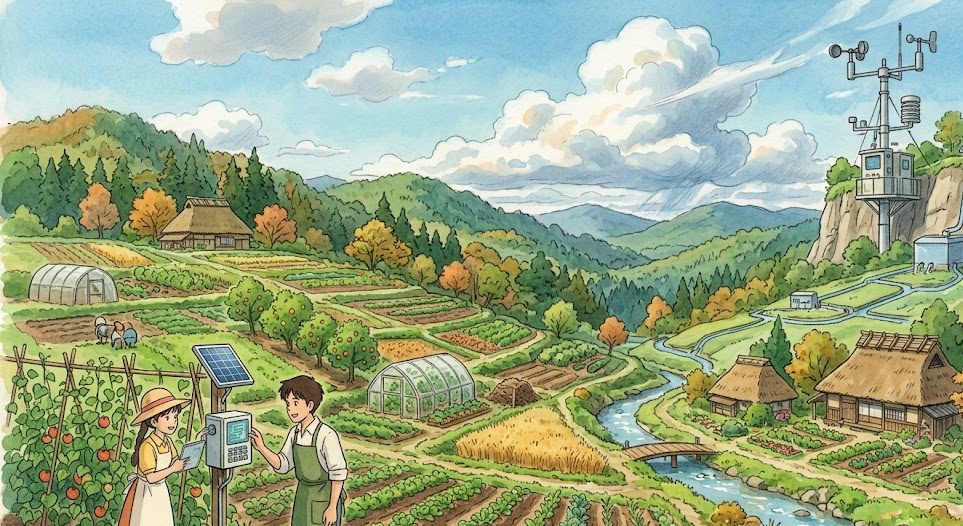
The global food system is at a critical crossroads. For decades, the agricultural industry followed a “chemical-first” philosophy—maximizing yields through heavy synthetic inputs and intensive tillage. While this fueled the Green Revolution, it left behind a legacy of depleted soils, disrupted local climates, and a food system vulnerable to the slightest environmental shift.
Today, a new paradigm is emerging: Nature-First Agriculture. This isn’t a retreat to primitive farming; rather, it is a sophisticated integration of Climate Intelligence, Advanced Soil Science, and Practical Crop Management. It is a system that views the farm as a biological engine rather than a factory floor.
1. The Pillar of Climate Intelligence: Predictive over Reactive
In the past, farmers relied on ancestral knowledge and local almanacs. While valuable, these are no longer sufficient in an era of rapid climate volatility. Climate intelligence involves using data-driven insights to synchronize farming activities with the shifting environment.
- Hyper-Local Forecasting: Modern Nature-First systems utilize IoT (Internet of Things) sensors and satellite imagery to move beyond general regional weather reports. By understanding the specific micro-climate of a single field, farmers can optimize irrigation schedules, preventing both water waste and crop stress.
- Climate-Adaptive Crop Selection: Using AI-driven models, farmers can predict which crop varieties will thrive in projected heatwaves or extended rainy seasons. This “intelligence” allows for a proactive shift in planting cycles, ensuring that the “Nature-First” approach is also “Result-First.”
- Risk Mitigation: By integrating climate data, we can anticipate pest outbreaks and disease vectors that are often triggered by specific humidity and temperature thresholds.
2. Advanced Soil Science: The Living Foundation
At the heart of Nature-First Agriculture is the realization that soil is not just “dirt”—it is a complex, living microbiome. Advanced soil science treats the earth as a long-term asset rather than a disposable medium.
The Soil Carbon Sponge
Healthy soil high in organic matter acts as a “carbon sponge.” For every 1% increase in soil organic matter, an acre of land can hold an additional 20,000 gallons of water. This is the ultimate defense against both drought and flooding.
The Microbiome Frontier
We are now beginning to understand the symbiotic relationship between plant roots and soil fungi (Mycorrhizae). Advanced soil management involves:
- Inoculation: Introducing beneficial microbes that help plants absorb phosphorus and nitrogen naturally.
- Minimal Disturbance: Transitioning to “No-Till” or “Low-Till” systems to keep the fungal networks intact.
- Bio-Stimulants: Moving away from NPK (Nitrogen, Phosphorus, Potassium) salts and toward organic stimulants that feed the soil biology, which in turn feeds the plant.
3. Practical Crop Management: Logic in the Field
Theory and science are useless if they cannot be applied practically on a 1,000-acre farm or a 1-acre homestead. Practical crop management is the “boots on the ground” execution of Nature-First principles.
| Strategy | Implementation | Benefit |
|---|---|---|
| Multi-Species Cover Cropping | Planting a “cocktail” of diverse plants between main seasons. | Prevents erosion, fixes nitrogen, and suppresses weeds naturally. |
| Precision Application | Using GPS-guided machinery to apply organic fertilizers only where needed. | Reduces costs and prevents runoff into local water systems. |
| Integrated Pest Management (IPM) | Using predatory insects and trap crops instead of blanket pesticides. | Maintains biodiversity and prevents chemical resistance. |
Export to Sheets
Regenerative Grazing Integration
One of the most practical ways to manage crops is to bring livestock back into the equation. Managed intensive grazing allows animals to fertilize the land and stimulate plant growth through natural “pruning,” mimicking the movement of wild herds. This creates a closed-loop system where waste becomes the primary input for the next cycle.
4. The Economic Logic: Why Nature-First Wins
Critics often argue that Nature-First Agriculture is a luxury. However, the hidden logic of this system is its Economic Resilience.
- Lower Input Costs: By leveraging nitrogen-fixing plants and healthy soil biology, farmers drastically reduce their bills for synthetic fertilizers and expensive chemical pesticides.
- Premium Market Access: As consumers become more “climate-conscious,” products grown under regenerative and nature-first labels often fetch higher prices in global markets.
- Subsidy and Carbon Credits: Many governments are shifting subsidies toward ecological outcomes. Farmers practicing Nature-First techniques are increasingly eligible for carbon sequestration credits, providing a new stream of “green” income.
5. Overcoming the Transition Gap
The shift from conventional to Nature-First agriculture isn’t instantaneous. There is often a “transition gap”—a period of 3 to 5 years where the soil is recovering its natural fertility. During this time, yields may fluctuate.
To bridge this gap, practitioners must use Stealth Logic:
- Incremental Shifts: Don’t flip the entire farm at once. Start with a 10% “pilot plot.”
- Data Backing: Use soil tests to prove the ROI of biological inputs over time.
- Community Knowledge: Join farmer-to-farmer networks to share practical “hacks” that science journals might miss.
6. The Future: A Tech-Enabled Garden
The future of agriculture is not a return to the plow; it is an evolution toward the Smart Garden. Imagine autonomous robots that pull weeds mechanically without chemicals, drones that plant cover crops into standing corn, and AI that adjusts irrigation based on real-time transpiration rates.
This is the synthesis of the “Nature-First” philosophy. It uses our highest intelligence to protect our most basic resource.
Conclusion: Harmony as a Strategy
Nature-First Agriculture is more than an environmental movement; it is a Strategic Necessity. By integrating climate intelligence, respecting the complexity of soil science, and applying rigorous practical management, we can build a food system that is both profitable and permanent.
The logic is simple: if we take care of the ecosystem, the ecosystem takes care of the yield. In the face of a changing climate, the most “advanced” thing we can do is align our technology with the wisdom of the natural world.
Final Thought: The goal is not to master nature, but to master the art of working with it. When the logic of the farm matches the logic of the forest, true sustainability is born.