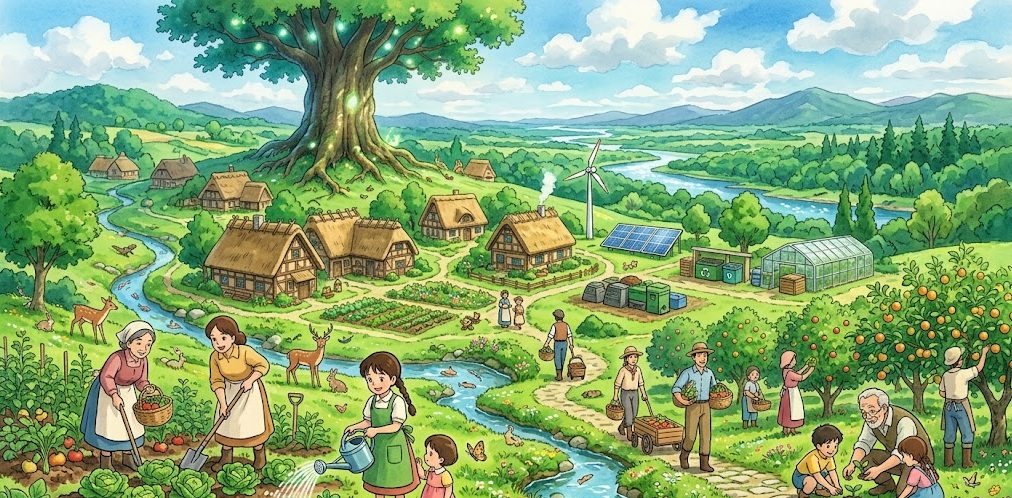
In the modern era, the word “Sustainability” is often tossed around in corporate boardrooms and political debates like a trendy buzzword. However, stripped of the marketing jargon, sustainability is a fundamental survival strategy. It is the practice of meeting our own needs without compromising the ability of future generations to meet theirs.
As we face unprecedented environmental shifts, the importance of taking care of the earth has shifted from a “kind gesture” to a global necessity. This post explores the core pillars of sustainability and how we can foster a healthier relationship with our planet.
1. The Triple Bottom Line: People, Planet, Profit
True sustainability isn’t just about planting trees; it’s about a balanced ecosystem. Experts often refer to the “Triple Bottom Line,” which suggests that for any system to be sustainable, it must be:
- Socially Equitable: Promoting fairness and health for all humans.
- Environmentally Sound: Protecting the biodiversity and resources of the earth.
- Economically Viable: Ensuring that we can maintain our lifestyles without bankrupting the future.
When we ignore one of these pillars—usually the environment in favor of short-term profit—the entire structure eventually collapses.
2. Why Our Current Trajectory Must Change
The Earth is a closed system. Aside from sunlight, we have a finite amount of water, air, and minerals. For the last century, the global economy has operated on a “Linear Model”: Take, Make, Dispose.
- Resource Depletion: We are extracting raw materials faster than the Earth can regenerate them.
- Waste Accumulation: Our oceans are filling with plastic, and our air is thick with carbon emissions.
- Climate Instability: The increase in greenhouse gases is leading to extreme weather patterns, threatening food security and coastal cities.
To survive, we must transition to a “Circular Economy”, where waste is designed out of the system and resources are kept in use for as long as possible.
3. The Power of Individual Action
It is easy to feel small in the face of global warming. However, systemic change is often driven by the collective weight of individual choices. Sustainability starts at home through simple, high-impact habits.
Conscious Consumption
Every dollar you spend is a vote for the kind of world you want. By choosing products with minimal packaging, supporting ethical brands, and buying only what we need, we signal to corporations that the “disposable” era is over.
The Energy Transition
Reducing our carbon footprint doesn’t always require solar panels on every roof (though that helps!). It can be as simple as:
- Switching to LED lighting.
- Improving home insulation to reduce heating/cooling needs.
- Opting for public transport, biking, or electric vehicles.
Diet and the Earth
Agriculture is one of the largest contributors to deforestation and water use. By incorporating more plant-based meals and reducing food waste, the average person can significantly lower their environmental impact.
4. Biodiversity: The Earth’s Immune System
Taking care of the earth means more than just lowering CO2 levels; it means protecting the variety of life. Every species, from the smallest bee to the largest whale, plays a role in keeping our air clean and our soil fertile.
Why Biodiversity Matters:
- Pollination: One-third of the world’s food supply depends on pollinators.
- Medicine: Over 50% of modern medicines are derived from natural compounds found in plants and fungi.
- Resilience: Diverse ecosystems are better at recovering from natural disasters.
When we destroy habitats, we aren’t just losing animals; we are dismantling the life-support systems that keep humans alive.
5. Corporate and Political Responsibility
While individual action is vital, the heavy lifting must be done by governments and large-scale industries. True sustainability requires:
- Policy Change: Carbon taxes, plastic bans, and subsidies for renewable energy.
- Green Innovation: Investing in carbon-capture technology and biodegradable materials.
- Global Cooperation: Treaties like the Paris Agreement are essential because the environment knows no borders.
6. The Psychological Benefit of Sustainability
Interestingly, taking care of the earth also takes care of us. Studies show that “Biophilia”—our innate connection to nature—is linked to lower stress levels, improved mental clarity, and better physical health. By living sustainably, we often find ourselves living more mindfully, focusing on experiences and connections rather than the accumulation of “stuff.”
7. Sustainability Strategies for Daily Life
| Category | Actionable Step | Environmental Impact |
| Waste | Composting organic waste | Reduces methane emissions from landfills. |
| Water | Fixing leaks & low-flow heads | Preserves precious freshwater reserves. |
| Fashion | Buying “Slow Fashion” | Reduces water pollution and textile waste. |
| Travel | Carbon offsetting flights | Balances out unavoidable emissions. |
8. Conclusion: A Legacy of Stewardship
The Earth does not belong to us; we belong to the Earth. We are currently the “stewards” of this planet, and the legacy we leave behind will be defined by the choices we make today.
Sustainability isn’t a sacrifice; it’s an investment in a world that is cleaner, fairer, and more vibrant. By respecting the limits of our natural world, we ensure that the beauty of the outdoors and the stability of our climate remain intact for the generations yet to be born.
It is time to stop viewing nature as a resource to be exploited and start viewing it as a home to be cherished.