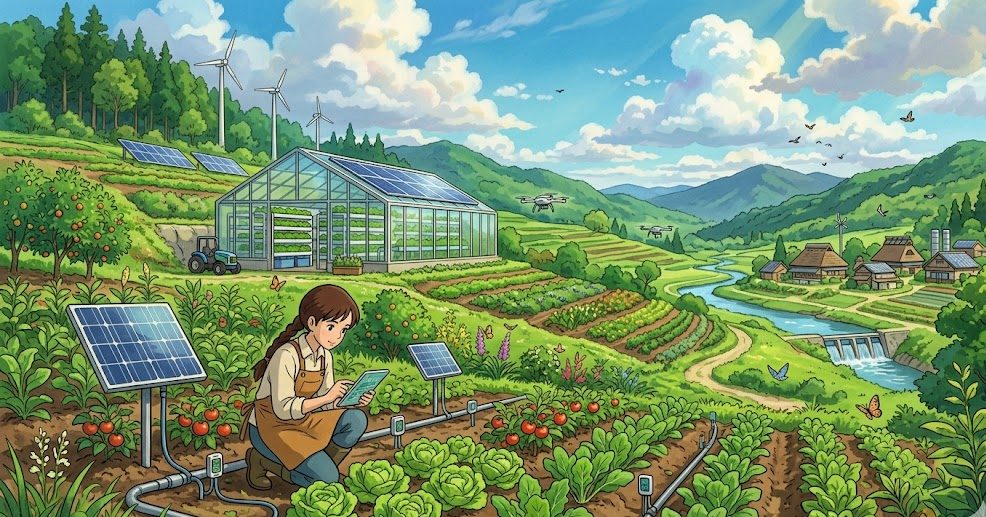
Agriculture is the backbone of human civilization, yet it faces its greatest challenge in history: feeding a global population projected to reach 10 billion by 2050 while navigating an increasingly erratic climate. The traditional, resource-heavy farming models of the 20th century are no longer sufficient. Today, a revolution is underway—the transition toward AgriTech innovation and Climate-Smart Agriculture (CSA).
This shift isn’t just about high-tech gadgets; it’s about creating a sustainable, resilient, and highly productive food system that protects both the farmer’s livelihood and the planet’s health.
What is the Future of Farming?
The future of farming lies in the convergence of biology, data, and automation. By moving away from “blanket” farming (where fields are treated uniformly) and toward “precision” farming (where every square meter is treated based on its specific needs), agriculture is becoming more efficient than ever before.
This transformation is driven by two main pillars:
- AgriTech Innovations: The technological tools that provide real-time data and automation.
- Climate-Smart Practices: The ecological strategies that ensure long-term soil health and carbon sequestration.
AgriTech: The Digital Transformation of the Field
Modern technology has turned farms into massive, data-driven laboratories. Here are the key technologies currently reshaping the landscape:
1. The Internet of Things (IoT) and Precision Sensors
IoT sensors are the “eyes and ears” of the modern farm. Buried in the soil or placed around the perimeter, these devices measure moisture levels, nutrient content, and pH balances. This data is transmitted to a central dashboard, allowing farmers to:
- Optimize Water Usage: Automated irrigation systems provide water only when and where it is needed, reducing water consumption by up to 35%.
- Fertilizer Precision: By knowing the exact nutrient deficiencies in a specific zone, farmers avoid over-application, saving costs and preventing chemical runoff into local water supplies.
2. Drones and Multispectral Imaging
Drones have revolutionized the way farmers scout their land. Equipped with multispectral cameras, they can see what the human eye cannot. They can detect early-stage plant diseases, moisture stress, and pest infestations before they become widespread. A single drone can survey hundreds of hectares in hours, a task that would take days on foot.
3. Artificial Intelligence (AI) and Predictive Analytics
AI acts as the “brain” that processes the immense volume of data collected by sensors and drones. Machine learning models analyze historical weather trends, crop prices, and soil data to help farmers make better decisions. For instance, AI can predict the optimal window for harvesting, ensuring the highest market value and lowest risk of spoilage.
Climate-Smart Agriculture (CSA): Building Resilience
While technology provides the tools, Climate-Smart Agriculture provides the framework. The goal of CSA is “triple-win”: increasing productivity, enhancing climate resilience, and reducing greenhouse gas emissions.
1. Conservation Agriculture
Conventional tilling often leaves soil vulnerable to erosion and moisture loss. Conservation agriculture promotes “no-till” or “reduced-tillage” practices, which keep the soil structure intact. By keeping the land covered with organic mulch or cover crops, farmers improve water retention and boost biodiversity.
2. Agroforestry
Agroforestry—the practice of integrating trees and shrubs into crop and livestock systems—is a powerhouse for sustainability. Trees act as windbreaks, provide shade for crops, and prevent soil erosion. Most importantly, they sequester carbon dioxide from the atmosphere, helping to mitigate the very climate change that threatens modern farming.
3. Climate-Resilient Crop Varieties
As weather patterns become more extreme, farmers are turning to bio-engineered and cross-bred crop varieties that are naturally drought-tolerant, heat-resistant, and salt-tolerant. These crops ensure that even if the season is unusually dry or hot, the harvest remains stable.
The Benefits of Integrating Tech and Nature
The combination of AgriTech and CSA creates a balanced approach to farming. The benefits are felt at every level of the supply chain:
| Benefit | Impact on Farming |
| Higher Profitability | Precision tools reduce the waste of seeds, water, and fertilizers. |
| Sustainability | Fewer chemicals and smarter soil management protect local ecosystems. |
| Risk Mitigation | Predictive tools help farmers prepare for droughts or floods in advance. |
| Resource Efficiency | Maximizing output per square foot allows for more food on less land. |
Overcoming Barriers to Adoption
Despite the clear benefits, adoption remains a challenge for many farmers due to high initial investment costs and the “digital divide” in rural areas. However, solutions are emerging:
- Government Subsidies: Many nations are now providing grants and low-interest loans to help farmers install smart irrigation and sensor arrays.
- Cooperative Models: Small-scale farmers are increasingly sharing the costs of drones, machinery, and software through cooperatives, democratizing access to high-end tech.
- Education: Ag-tech companies are focusing on user-friendly interfaces, making it easier for traditional farmers to interpret data without needing a degree in computer science.
Looking Ahead: The Path Toward 2050
The future of agriculture is not just about producing more; it’s about producing better. By weaving together the intelligence of data science with the wisdom of ecological conservation, the next generation of farmers will be stewards of the land rather than just exploiters of it.
As we look toward 2050, the farms that survive and thrive will be those that view their fields as dynamic ecosystems. They will leverage AI to anticipate the climate, drones to monitor their crops, and soil health as their most valuable financial asset.
Agriculture is evolving. Those who embrace these innovations today will be the pioneers of a more secure, nutritious, and sustainable world for all.
Final Thoughts for the Reader
Are you a farmer, an agriculture student, or simply someone interested in the intersection of tech and sustainability? The transition to smart farming is an incremental journey. Start by identifying one “bottleneck” in your production process—whether it’s water management, crop monitoring, or soil health—and look for a technology-driven or conservation-based solution to address it. Every small step toward data-driven decision-making helps build a more resilient future.