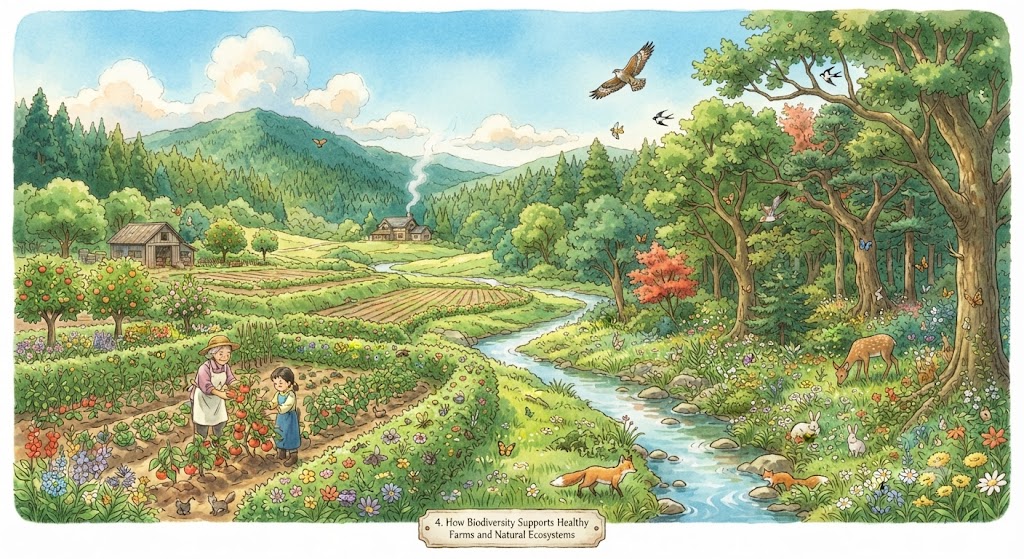
A productive farm is more than rows of crops, fields of grass, or groups of livestock. It is part of a much larger living system that includes insects, birds, soil organisms, plants, fungi, water, and wildlife.
This variety of life is known as biodiversity, and it can play an important role in both agricultural production and the health of surrounding ecosystems.
On farms across the United States and United Kingdom, biodiversity can be supported in many different ways. Flowering field margins can provide food for pollinating insects, hedgerows can offer shelter for birds and small mammals, diverse crop rotations can improve the resilience of farming systems, and healthy soils can support enormous communities of microorganisms.
Biodiversity does not mean that farmers have to turn productive farmland into unmanaged wilderness. Instead, the goal is often to create a balanced agricultural landscape where food production and natural processes can work alongside each other.
Understanding this relationship can help farmers make practical decisions that benefit both the farm and the wider environment.
What Does Biodiversity Mean?
Biodiversity refers to the variety of living organisms found within an environment.
On a farm, biodiversity can include much more than the animals that are easy to see.
It may involve:
- Crops and wild plants
- Bees and other pollinators
- Birds
- Earthworms
- Beetles
- Spiders
- Soil bacteria
- Fungi
- Small mammals
- Amphibians
- Reptiles
- Livestock
- Natural predators
These organisms interact with one another in complex ways.
For example, flowering plants can provide food for insects. Insects can pollinate crops or become food for birds. Predatory insects and spiders can feed on other insects. Dead plant material can be broken down by microorganisms and contribute to nutrient cycling.
This means biodiversity is not simply about having more species. It is also about maintaining useful relationships between living organisms.
Why Biodiversity Matters on Farms
Agriculture depends on natural processes more than many people realise.
Soil organisms help break down organic material. Pollinating insects support many crops. Vegetation can help protect soil from erosion. Predators can contribute to natural pest control.
When agricultural landscapes contain a wider range of habitats and organisms, they can provide more opportunities for these natural processes to occur.
This does not guarantee higher yields in every situation. Farming outcomes depend on many factors, including weather, soil, crop variety, management, markets, and available resources.
However, biodiversity can contribute to the overall resilience of an agricultural system.
A diverse farm landscape can also provide benefits beyond production, including wildlife habitat, water protection, landscape quality, and opportunities for recreation or education.
Pollinators Are an Important Part of the System
Bees are among the best-known agricultural pollinators, but they are not the only ones.
Other insects, including some butterflies, moths, flies, and beetles, can also contribute to pollination.
Pollination is particularly important for crops that depend on insects to transfer pollen between flowers.
Farmers can support pollinator populations by providing suitable food and habitat.
Flowering plants that bloom at different times can help provide resources across a longer part of the growing season.
Hedgerows, field margins, wildflower areas, and appropriately managed vegetation can also create useful habitat.
For US and UK farms, plant selection should be based on local conditions and native or otherwise suitable species where appropriate.
The objective is to provide reliable habitat without introducing plants that could become problematic in the local environment.
Hedgerows Can Provide More Than Boundaries
Hedgerows have a long history in parts of the United Kingdom, where they have traditionally been used to divide fields and manage livestock.
They can also provide habitat for birds, insects, small mammals, and other wildlife.
A well-managed hedgerow can offer food, nesting opportunities, shelter, and movement routes across agricultural landscapes.
Similar concepts can be applied in other regions using locally appropriate vegetation.
Shelterbelts, tree lines, native plant strips, and vegetated field boundaries can provide comparable ecological functions in some US farming systems.
The design should reflect local climate, soil, farm operations, and wildlife needs.
Healthy Soil Is Full of Life
Soil biodiversity is often overlooked because most of it is hidden underground.
A healthy soil can contain enormous numbers of microorganisms along with earthworms and other organisms.
These living communities participate in decomposition and nutrient cycling.
Plant roots interact with soil organisms in complex ways. Some microorganisms can form relationships with plants, while decomposers help break down organic material.
Earthworms can also influence soil structure by creating channels and moving organic material through the soil.
Farmers can support soil biodiversity through practices such as maintaining organic matter, reducing unnecessary disturbance, using suitable crop rotations, and keeping living roots in the soil when practical.
The exact effect of each practice depends on soil type and management conditions.
Crop Diversity Can Strengthen Farming Systems
Growing a wide range of crops can provide benefits at both the farm and ecosystem level.
Different crops have different root structures, nutrient requirements, growth patterns, and residues.
A diverse crop rotation can therefore change the conditions experienced by pests, diseases, weeds, and soil organisms from one season to the next.
For example, alternating crops rather than planting the same crop repeatedly can interrupt some pest and disease cycles.
Including crops with different root systems can also influence soil structure and organic matter in different ways.
The best rotation depends on the farm.
A large grain operation in the American Midwest may use a different rotation from an arable farm in England or a mixed farm in Scotland.
The principle is to avoid treating every season as an isolated event and instead consider how crops interact over multiple years.
Natural Predators Can Help With Pest Management
Not every insect found on a farm is a pest.
Many insects are predators or parasitoids that feed on organisms that damage crops.
Ladybirds, lacewings, predatory beetles, spiders, and other beneficial organisms can contribute to natural pest control.
Birds and bats can also consume insects, depending on the species and local environment.
Maintaining habitat for these organisms can sometimes help create conditions for natural pest regulation.
This is one reason integrated pest management takes the wider ecosystem into account.
Rather than trying to eliminate every insect, farmers can monitor pest populations and consider whether intervention is actually necessary.
When treatment is required, targeted approaches can help reduce unnecessary impacts on non-target organisms.
Biodiversity and Water Quality
Agricultural runoff can carry soil particles, nutrients, and other materials into nearby waterways.
Vegetated areas can help slow water movement and capture some sediment before it reaches streams, ponds, or rivers.
Buffer strips along waterways can therefore serve both agricultural and environmental purposes.
Plants in these areas can stabilise soil with their roots, while above-ground vegetation can slow runoff.
Wetlands can also provide important habitat while interacting with water within the landscape.
The design and management of buffer zones should take local regulations and environmental conditions into account.
In the UK, protecting watercourses is an important consideration for agricultural land management. Similar concerns exist across many US agricultural regions.
Trees and Agroforestry
Trees can contribute another layer of biodiversity to agricultural landscapes.
Agroforestry combines trees with crops, livestock, or other agricultural activities.
Depending on the system, trees can provide shade, shelter, habitat, products, and other benefits.
Examples can include:
- Trees within grazing areas
- Shelterbelts around fields
- Orchard systems
- Tree rows combined with crops
- Riparian planting near waterways
Trees can also provide habitat for birds and insects.
However, introducing trees is not automatically appropriate for every field. They can compete with crops for light, water, and nutrients, and their placement may affect machinery operations.
Good planning is therefore important.
Wildlife Corridors Help Connect Habitats
Agricultural landscapes can sometimes separate natural habitats into smaller areas.
Wildlife corridors can help connect these areas.
A corridor might consist of a hedgerow, woodland strip, grassland margin, streamside vegetation, or another suitable habitat.
Connected habitats can make it easier for some species to move between locations.
This can be particularly valuable where agricultural fields dominate the landscape.
Corridors do not need to occupy large portions of every farm. Strategic placement can sometimes provide useful connections between existing natural areas.
The appropriate design depends on the species being supported and the surrounding landscape.
Farm Margins Can Provide Valuable Habitat
The edges of agricultural fields are sometimes treated as unproductive space.
However, field margins can provide habitat for many organisms.
A margin may contain grasses, wildflowers, shrubs, or other vegetation.
These areas can offer shelter and food while creating a transition between cultivated land and surrounding habitats.
Farmers can manage margins according to their goals.
For example, some areas may be managed primarily for pollinators, while others may be designed to provide nesting habitat or reduce erosion.
Management timing can also matter. Cutting vegetation at the wrong time can reduce its value for wildlife, so local guidance can help determine appropriate practices.
Livestock Farms Can Support Biodiversity Too
Biodiversity is not limited to crop farms.
Livestock systems can also contain diverse habitats.
Pastures may support grasses, flowering plants, insects, birds, and soil organisms.
Grazing itself can influence vegetation structure.
Carefully managed grazing can maintain a mixture of plant heights and create different habitat conditions. However, excessive grazing can reduce plant diversity and damage soil.
This is why stocking levels and grazing timing matter.
Farmers can use rotational grazing or other management systems where suitable to distribute grazing pressure and protect vulnerable areas.
The right approach depends on livestock type, soil, rainfall, forage availability, and farm objectives.
Biodiversity Can Support Farm Resilience
A farm with greater biological diversity may have more natural processes available to respond to changing conditions.
For example, diverse vegetation can provide different types of habitat. Healthy soils can support complex biological activity. Crop diversity can reduce reliance on a single species.
This can contribute to resilience, although biodiversity is not a guarantee against crop losses or extreme weather.
Farming remains exposed to droughts, floods, storms, pests, disease, market changes, and other risks.
The value of biodiversity is better understood as one component of a broader risk-management strategy.
Biodiversity Does Not Require Abandoning Productivity
One common misconception is that supporting biodiversity means sacrificing productive agriculture.
In practice, biodiversity measures can often be incorporated into working farms.
A farmer might maintain a strip of habitat around the edge of a field while continuing to cultivate the main production area.
Another farmer might plant a cover crop that protects soil while also providing habitat for certain organisms.
A livestock producer may use grazing management that maintains pasture quality while supporting a wider range of plants.
These approaches demonstrate that productive agriculture and environmental stewardship do not always have to be separate activities.
The key is finding practices that fit the particular farm.
Start Small and Monitor the Results
Farmers interested in improving biodiversity do not need to transform their entire property immediately.
A small pilot project can be a useful starting point.
For example, a farmer could:
- Identify an unused or low-productivity area.
- Determine which habitat would be suitable locally.
- Plant appropriate vegetation or manage existing vegetation differently.
- Monitor insects, birds, plants, and other wildlife.
- Observe whether the area creates any practical farm-management benefits.
- Adjust the approach based on the results.
Records can make the process more useful.
Farmers might photograph the same area throughout the year, record flowering periods, or monitor particular species.
Over several seasons, this information can show how the habitat is developing.
How Technology Can Help Monitor Biodiversity
Modern technology is making ecological monitoring easier.
Farmers and researchers can use cameras, GPS mapping, drones, satellite imagery, and digital recording tools to monitor habitats and landscape changes.
Wildlife cameras, for example, can record animals without requiring people to be present.
Mapping software can show where hedgerows, wetlands, ponds, woodland, and other habitats are located across a farm.
These tools can help farmers understand how different parts of their property are connected.
Technology should complement, rather than replace, direct observation and local ecological knowledge.
Supporting Biodiversity in the Wider Landscape
A single farm can make a difference, but biodiversity is often most effective when habitats connect across larger landscapes.
Neighbours can coordinate buffer areas, hedgerows, wildlife corridors, or other habitat projects.
This can create larger connected areas rather than isolated patches.
In both the US and UK, agricultural landscapes can contain a mixture of farms, woodlands, rivers, roads, towns, and natural areas.
Coordinated management can therefore provide benefits that extend beyond individual property boundaries.
A Practical Biodiversity Checklist for Farms
Farmers looking for simple ways to consider biodiversity can start with a few questions:
Are there flowering plants available throughout the growing season?
If not, suitable field margins or other flowering areas may provide additional resources for pollinators.
Does the farm contain protected or connected habitat?
Hedgerows, tree lines, grass margins, ponds, and wetlands can provide important habitat depending on their condition.
Is the soil biologically active?
Maintaining organic matter, reducing unnecessary disturbance, and using diverse rotations can support soil life.
Are beneficial insects being protected?
Regular pest monitoring can help determine whether treatment is necessary and whether targeted approaches can reduce unnecessary effects on non-target organisms.
Are waterways protected?
Vegetated buffers can help reduce runoff and provide habitat.
Could farm practices be adjusted gradually?
Small changes can be tested before larger investments are made.
Looking at the Farm as a Living System
Modern agriculture depends on technology, machinery, markets, fertilisers, irrigation, and many other tools. But beneath all of these systems is a biological environment that continues to influence how farms operate.
Biodiversity helps connect the different parts of that environment.
Pollinators interact with plants. Predators interact with pests. Soil organisms interact with roots and organic matter. Vegetation influences water movement and provides habitat. Birds, insects, mammals, and microorganisms all occupy different positions within the agricultural landscape.
Farmers do not need to manage every part of this system perfectly. Instead, understanding these relationships can help them make more informed decisions.
Building Farms That Work With Nature
Healthy farms and healthy ecosystems do not have to be viewed as completely separate goals.
A productive farm can include wildlife habitat. A crop field can exist alongside flowering margins. Livestock pasture can support diverse vegetation. Soil can be managed as a living system rather than simply a place to grow plants.
The most practical approach is usually specific to the farm.
What works on a large wheat operation in England may not be appropriate for a cotton farm in Texas. A hedgerow strategy suitable for one region may need to be replaced with native grassland, shelterbelts, or other habitat in another.
The underlying principle remains the same: healthy agricultural landscapes depend on a variety of living organisms and the relationships between them.
By protecting soil life, maintaining suitable habitats, supporting pollinators, managing water responsibly, diversifying crops, and preserving natural areas where practical, farmers can contribute to ecosystems while continuing to produce food.
Biodiversity is therefore not simply an environmental concept. It is one part of the living foundation on which agriculture itself depends.