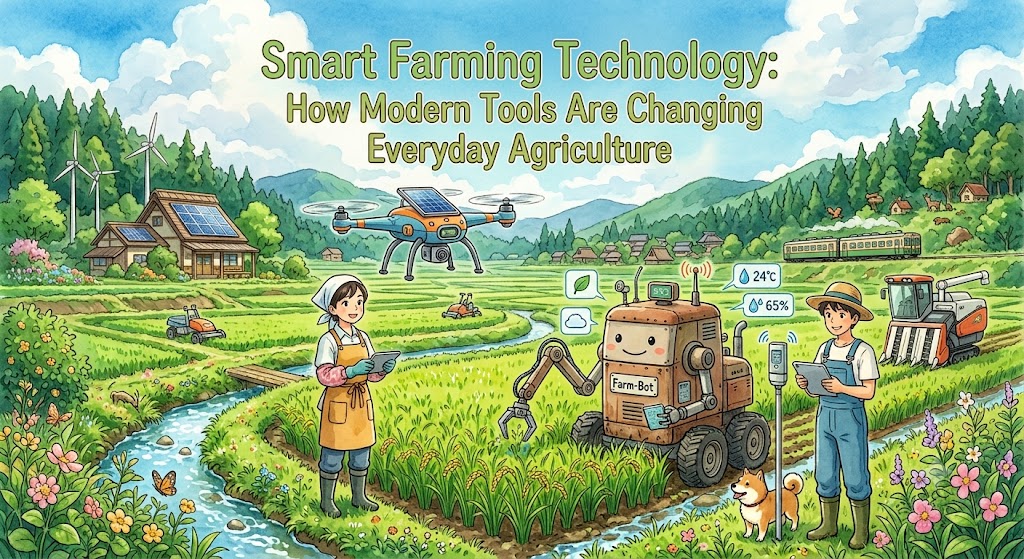
Agriculture has always depended on experience, timing, weather, and careful observation. For generations, farmers have learned to understand their land by watching the soil, studying the sky, checking crops, and adjusting their methods according to the season. Today, those traditional skills are being supported by a new generation of technology.
Smart farming technology is changing the way everyday agricultural work is planned and managed. Farmers can now use sensors to understand soil conditions, satellite images to observe crop areas, automated irrigation systems to manage water, drones to inspect fields, and digital platforms to organize important information. These tools do not necessarily replace traditional farming knowledge. Instead, they can give farmers additional information that helps them make more informed decisions.
The idea behind smart farming is relatively simple: use technology to understand what is happening on a farm and respond more efficiently.
From small farms to large agricultural operations, these technologies are creating new possibilities for managing resources, monitoring crops, and improving daily farm routines.
What Is Smart Farming?
Smart farming refers to the use of modern digital and technological tools to manage agricultural activities more efficiently. It combines agriculture with technologies such as sensors, connected devices, GPS, satellite imagery, automation, mobile applications, data analysis, and artificial intelligence.
Traditional farming often relies heavily on visual inspection and personal experience. While experience remains extremely valuable, modern tools can provide additional measurements that may not always be visible to the human eye.
For example, a farmer may know that a field looks dry, but a soil moisture sensor can provide a more specific indication of moisture conditions. Similarly, a farmer may notice that part of a crop looks unhealthy, while aerial imagery can help identify patterns across a larger field.
Smart farming therefore focuses on collecting useful information and turning that information into practical decisions.
It can be used for many everyday activities, including irrigation, crop monitoring, soil management, equipment tracking, weather observation, and farm record keeping.
Soil Sensors Are Making Field Monitoring More Precise
Soil is one of the most important parts of agriculture, and understanding its condition can make everyday farm management easier.
Modern soil sensors can measure different characteristics depending on the type of sensor being used. Some systems monitor moisture levels, while others can collect information about temperature, electrical conductivity, or other soil-related conditions.
This information can help farmers understand when different areas of a field may require attention.
Instead of treating an entire field exactly the same, farmers can potentially identify areas that have different needs. One section may retain more moisture than another, for example.
This approach is often associated with precision agriculture because it allows farm activities to be managed according to specific field conditions.
Sensors can also collect information regularly. When connected to a digital platform, measurements may be viewed through a phone, computer, or other device.
The result is a more data-driven approach to understanding what is happening below and around the crops.
Smart Irrigation Helps Manage Water
Water management is another area where technology is having a noticeable impact.
Traditional irrigation methods can sometimes involve watering an entire field according to a fixed schedule. Smart irrigation systems can instead use information such as soil moisture, weather conditions, crop requirements, or programmed schedules to determine when irrigation should occur.
Some systems can automatically control pumps, valves, or irrigation zones.
For farmers, this can make irrigation management more convenient. Instead of manually checking every part of a field at every moment, automated systems can handle certain repetitive tasks according to predefined settings.
The exact benefit depends on the farm, crop, irrigation system, soil, and local conditions. Technology does not automatically guarantee lower water use, but accurate monitoring and better scheduling can help farmers manage water more carefully.
This becomes especially useful in areas where water availability is limited or where irrigation needs to be closely controlled.
Drones Give Farmers a Different View of Their Fields
A field can look completely different from above.
Agricultural drones equipped with cameras can capture aerial images that allow farmers to inspect large areas more efficiently. Depending on the equipment, drones may capture standard photographs or specialized imagery that can reveal differences in vegetation and field conditions.
A drone can help identify areas that may deserve closer inspection. For example, unusual crop patterns, damaged sections, standing water, or uneven growth may become easier to notice from an aerial perspective.
Farmers can then investigate those areas on the ground.
The important point is that drones are not simply flying cameras. When combined with mapping software and agricultural analysis tools, aerial data can become part of a larger crop-monitoring system.
However, drone use also requires appropriate equipment, skills, and compliance with applicable aviation and local regulations.
GPS and Precision Agriculture
GPS technology has become an important part of modern agricultural equipment.
Farm machinery can use positioning technology to help farmers understand where equipment is operating and how different areas of a field are being covered.
Precision agriculture can use GPS-based information to create detailed field maps and support activities such as planting, spraying, harvesting, and equipment guidance.
One advantage of accurate positioning is consistency. When machines can follow planned routes, farmers may be able to reduce unnecessary overlaps or missed areas during certain operations.
Modern agricultural machinery can also store information about field operations, allowing farmers to review what was done and where it happened.
For large farms especially, keeping track of these activities manually can become difficult. Digital records can make the process more organized.
Weather Technology Supports Better Planning
Weather has always played a major role in farming.
Rainfall, temperature, wind, humidity, and extreme weather conditions can affect planting, irrigation, spraying, harvesting, and crop development.
Farmers now have access to weather stations, forecasting services, connected sensors, and mobile applications that provide more detailed information than a simple general weather forecast.
On-farm weather stations can collect localized information. This can be useful because weather conditions may vary significantly between locations.
Digital weather tools can also help farmers plan activities around expected conditions.
For example, if strong winds or rainfall are expected, a farmer may decide to postpone certain field operations. The technology does not remove weather-related uncertainty, but it can provide more information for planning.
Artificial Intelligence Is Entering Agriculture
Artificial intelligence is becoming another part of the smart farming ecosystem.
AI systems can analyze large amounts of agricultural information and identify patterns that may be difficult to recognize manually. Depending on the application, AI can be used for crop monitoring, image analysis, equipment maintenance, forecasting, and decision-support systems.
Computer vision is particularly interesting for agriculture.
A camera can capture images of plants, and software can analyze those images for visible characteristics. In some applications, AI models can help identify weeds, recognize signs of crop stress, or distinguish between different objects in a field.
The quality of these systems depends heavily on the data, hardware, environment, and model being used. AI should therefore be treated as a tool that supports agricultural decisions rather than as a replacement for farmers’ experience.
Farm Management Apps Are Putting Information in One Place
Not every useful agricultural technology needs to be complicated machinery.
A smartphone can become an important farming tool.
Farm management applications can help farmers record planting dates, track field activities, maintain equipment information, monitor expenses, organize tasks, and store other farm records.
Keeping accurate records can be extremely useful over time.
Instead of relying entirely on notebooks or memory, farmers can maintain digital information that can be searched and reviewed later.
Some platforms can also combine information from weather services, sensors, machinery, and field maps.
This creates a more connected approach to farm management, where different types of information can be viewed from a single system.
Smart Greenhouses Create More Controlled Growing Conditions
Technology is also changing agriculture inside greenhouses.
Modern greenhouse systems can monitor temperature, humidity, light levels, soil or growing-medium moisture, and other environmental conditions.
Automated equipment can then control certain functions such as ventilation, irrigation, heating, cooling, or lighting.
The goal is to create a more consistent growing environment.
For crops that require particular environmental conditions, this level of monitoring can be valuable. Instead of checking every condition manually throughout the day, sensors can continuously collect information.
Some advanced greenhouse systems can even connect environmental data with automated control systems.
This represents a broader trend in agriculture: technology is moving from simply measuring conditions toward automatically responding to them.
Robots and Automation Are Reducing Repetitive Work
Agricultural automation is another rapidly developing area.
Machines and robots are being designed to assist with repetitive activities such as harvesting, weeding, planting, transportation, and crop inspection.
Some agricultural robots use cameras and sensors to navigate fields. Others are designed for specific crops or tasks.
Automation can be particularly useful for repetitive jobs that require large amounts of time and labor.
However, agricultural robots are not suitable for every farm. Their usefulness depends on crop type, field conditions, farm size, cost, available technical support, and the specific task involved.
For many farmers, the future may not mean completely automated farms. Instead, it may involve a combination of human workers, conventional machinery, and specialized automated systems.
Why Data Matters in Smart Farming
One of the biggest changes brought by smart farming is the growing importance of agricultural data.
Farmers can collect information about soil, weather, crops, irrigation, machinery, expenses, and field operations.
Individually, each piece of information may seem small. Over time, however, a collection of records can reveal useful patterns.
A farmer might compare crop performance across different parts of a field or review irrigation records from previous seasons. These comparisons can support future planning.
Good data is only useful when it is accurate and understandable. Too much information can also become confusing.
For this reason, successful smart farming is not simply about collecting as much data as possible. It is about collecting relevant information and using it in a practical way.
Smart Farming Can Also Support Smaller Farms
Smart farming is sometimes associated with large commercial farms and expensive machinery, but smaller farms can also benefit from selected technologies.
A farmer does not need to install an advanced automated system across an entire property to begin using digital tools.
A basic weather station, irrigation timer, soil moisture sensor, farm-management application, or mobile mapping tool may provide useful information.
The right technology depends on the farm’s needs.
For a small operation, a simple and affordable tool that solves a specific problem may be more useful than a complex system with features that are rarely used.
This makes gradual adoption an important part of agricultural technology.
Challenges of Adopting Smart Farming Technology
Despite its advantages, smart farming also has challenges.
Cost is one of the most obvious barriers. Sensors, drones, machinery upgrades, software subscriptions, connectivity, and maintenance can require significant investment.
There can also be a learning curve.
Farmers may need training to understand how to operate equipment, interpret data, troubleshoot systems, and maintain connected devices.
Internet connectivity can be another issue, especially in rural areas where reliable connections may not always be available.
Data management and security are also becoming increasingly important as farms use more connected devices and online platforms.
Technology should therefore be introduced based on actual agricultural needs rather than simply because a tool is new.
The Future of Everyday Agriculture
The future of farming is likely to involve a combination of traditional agricultural knowledge and modern technology.
Farmers will continue to rely on practical experience, local knowledge, observation, and an understanding of crops and land. At the same time, sensors, automation, satellite imagery, AI, drones, and digital management systems can provide additional information.
The most interesting development may be the way these technologies work together.
Imagine a system where soil sensors provide moisture information, a weather station provides local conditions, satellite imagery shows crop changes, and a mobile application brings the information together. Such a system could give farmers a clearer picture of what is happening across their operation.
Technology can also become increasingly accessible as hardware costs, software tools, and connectivity continue to develop.
Rather than one dramatic transformation, agriculture may experience thousands of smaller improvements in everyday tasks.
Final Thoughts
Smart farming technology is changing agriculture by making information more accessible and many routine activities more measurable and manageable.
From soil sensors and smart irrigation to drones, GPS machinery, AI systems, weather stations, and farm-management applications, modern tools are giving farmers new ways to understand their fields and organize their work.
The purpose of smart farming is not simply to make agriculture more technological. The real value comes from using technology to solve practical problems.
Every farm is different, and there is no single technology that works equally well everywhere. The most useful approach is to identify a specific challenge, choose an appropriate tool, and evaluate whether it actually improves the farming process.
As technology continues to develop, agriculture is likely to become increasingly connected and data-driven. At the same time, the knowledge and experience of farmers will remain an essential part of the process.
Smart farming is therefore not about replacing traditional agriculture. It is about giving farmers additional tools to make everyday decisions with better information.