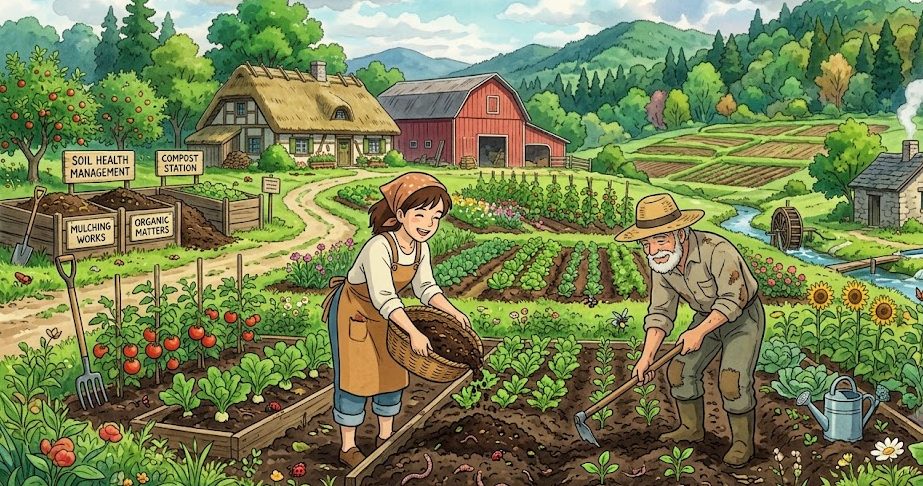
Healthy soil is one of the most valuable resources on any farm. It supports plant roots, stores water, provides nutrients, contains countless microorganisms, and helps crops develop throughout the growing season. When soil becomes compacted, depleted, excessively dry, or poorly managed, crop production can become more difficult and expensive.
Soil health management is the practice of maintaining and improving the physical, chemical, and biological condition of soil over time. It is not based on one single treatment or product. Instead, it involves a combination of farming practices that protect the soil while helping it support healthy crops.
Good soil management can begin with simple steps. Farmers can reduce unnecessary soil disturbance, add organic matter, maintain plant cover, manage water carefully, rotate crops, and regularly observe soil conditions.
The goal is not simply to make soil productive for one season. Sustainable soil management focuses on maintaining useful soil conditions for many growing seasons.
What Does Soil Health Actually Mean?
Soil health describes how well soil functions as a living and productive system.
A healthy soil can support plant growth while handling water, nutrients, air, roots, and biological activity effectively. It contains minerals and organic materials, but it is also home to bacteria, fungi, earthworms, insects, and other organisms that contribute to natural soil processes.
Soil health has several connected parts.
Physical health relates to soil structure, compaction, water movement, and the ability of roots to grow.
Chemical health includes nutrient availability, pH, salinity, and other chemical characteristics.
Biological health relates to microorganisms and other living organisms that contribute to decomposition and nutrient cycling.
These areas influence one another. For example, compacted soil can restrict root growth and reduce the movement of water and air. Poor organic matter levels can also affect soil structure and biological activity.
For this reason, soil should be managed as a complete system rather than focusing on one measurement alone.
Start by Understanding the Soil You Have
Before changing a soil-management program, it helps to understand the existing condition of the field.
A basic soil test can provide useful information about characteristics such as pH and nutrient levels. Depending on the testing service, additional information may also be available.
Soil testing can help farmers make more informed decisions about amendments and fertilizers rather than applying materials without knowing what the soil actually needs.
Farmers can also observe the soil directly.
Look at how easily water enters the ground after irrigation or rainfall. Check whether roots are growing normally. Notice whether certain areas remain wet for too long or become unusually dry. Examine whether the soil forms hard layers or large clumps.
These observations can reveal differences between parts of the same field.
Combining soil tests with field observations creates a more complete picture.
Add Organic Matter Regularly
Organic matter is one of the most important components of healthy agricultural soil.
It comes from decomposed plant material, roots, manure, compost, and other biological sources. As organic materials break down, they contribute to the soil environment and support biological activity.
Organic matter can also improve soil structure and help the soil hold and manage water.
Farmers can increase organic matter through several approaches. Crop residues can sometimes be left in the field instead of being completely removed. Compost or properly managed organic amendments may also be incorporated where appropriate.
The key is consistency.
Adding organic material once does not permanently transform soil. Building soil organic matter is a gradual process that depends on climate, soil type, cropping systems, and management practices.
Keep Soil Covered Whenever Possible
Bare soil is more exposed to environmental conditions.
Rain can wash away loose soil particles, while wind can move dry soil from exposed fields. Strong sunlight can also increase surface drying.
Maintaining plant cover can provide a protective layer.
Cover crops are one common approach. These crops are grown primarily to protect and improve the soil rather than being harvested as the main cash crop.
Cover crops can help reduce erosion, provide additional plant residues, support biological activity, and improve the way water interacts with the soil.
Different cover crops provide different characteristics, so selection should consider local climate, soil conditions, available water, and the following crop.
Even crop residues left after harvest can provide useful surface protection.
Consider Cover Crops as Part of the Rotation
Cover crops become even more useful when they are incorporated into a broader crop rotation strategy.
For example, a farmer may grow a cereal crop during one season, followed by another crop with different rooting characteristics, and use a cover crop during a suitable period between production cycles.
Different plants interact with soil in different ways.
Some develop deeper root systems, while others produce large amounts of surface biomass. Certain plant families can also contribute nitrogen-related benefits when properly managed.
The purpose of rotation is not simply to change crops for variety. A well-planned rotation can help break repeated production patterns and provide different benefits to the soil.
However, rotation plans should always be adapted to the local farming system and crop requirements.
Reduce Unnecessary Soil Disturbance
Tillage has an important role in agriculture, but excessive or unnecessary disturbance can affect soil structure.
Repeated intensive tillage can break apart soil aggregates and leave soil more exposed to erosion. It can also disturb soil organisms and affect moisture conditions.
Conservation tillage, reduced tillage, or no-till systems are approaches that aim to reduce the amount of soil disturbance.
These methods are not automatically suitable for every field.
Farmers need to consider weed pressure, residue levels, soil type, climate, equipment, crop requirements, and other practical factors before changing their tillage system.
The broader principle is simple: disturb the soil only as much as necessary for the farming operation.
Manage Water Carefully
Water management is closely connected with soil health.
Too little water can stress crops and increase soil dryness. Too much water can reduce air movement through soil and create conditions that are unfavorable for roots.
Good irrigation management begins with understanding how much water the crop needs and how quickly the soil is losing moisture.
Soil moisture sensors can provide useful information, but farmers can also use direct observation and established irrigation practices.
Improving soil structure and organic matter can also influence how water moves and remains available in the soil.
Efficient irrigation should therefore be viewed as part of an overall soil-management strategy rather than as a completely separate activity.
Avoid Soil Compaction
Compacted soil can become a serious problem, especially where heavy machinery repeatedly travels over the same areas.
Compaction reduces the spaces between soil particles. This can make it more difficult for roots to expand and can interfere with the movement of water and air.
Farmers can reduce unnecessary compaction by avoiding field traffic when soils are excessively wet, using planned traffic routes where practical, and managing machinery loads carefully.
Deep-rooted plants can sometimes help improve soil structure over time, although their effectiveness depends on soil conditions.
Compaction is often easier to prevent than to correct, so monitoring high-traffic areas can be particularly useful.
Encourage Healthy Soil Biology
Soil is not just a collection of minerals.
It is a living environment containing bacteria, fungi, earthworms, insects, and many other organisms.
These organisms contribute to decomposition, nutrient cycling, organic matter breakdown, and other soil processes.
Practices that provide organic material and reduce unnecessary disturbance can support a more active soil ecosystem.
Crop residues, compost, diverse rotations, and plant roots all contribute organic inputs.
A biologically active soil does not necessarily mean that every microorganism must be measured or controlled. Instead, the goal is to create conditions where useful biological processes can naturally take place.
Use Fertilizers Based on Actual Crop Needs
Fertilizers can play an important role in crop production, but application should be based on crop requirements and soil conditions.
Applying too little fertilizer can limit plant growth, while excessive applications may waste resources and contribute to environmental problems.
Soil testing can help identify nutrient levels and guide fertilizer decisions.
A balanced nutrient-management plan considers the crop, soil, expected yield, previous crops, organic inputs, and other relevant factors.
Farmers should also follow local agricultural recommendations because nutrient requirements can vary considerably between crops and regions.
The goal is not to eliminate fertilizer use. It is to apply nutrients carefully and efficiently.
Pay Attention to Soil pH
Soil pH influences how plants access different nutrients.
Different crops have different preferred pH ranges, and nutrient availability can change as soil pH changes.
A soil test can help determine whether pH is within a suitable range for the intended crop.
If correction is necessary, the appropriate amendment and application rate should be determined based on soil-test results and local recommendations.
Making major pH changes without testing can create new problems, so measurement should come before treatment.
Prevent Erosion Before It Becomes a Problem
Soil erosion removes valuable topsoil from agricultural fields.
Wind and water are two major causes.
Heavy rainfall can move soil particles downhill, while strong winds can carry dry soil away from exposed fields.
Several management practices can reduce erosion.
Maintaining vegetation, leaving crop residues on the soil surface, using appropriate contour-based practices where suitable, and reducing unnecessary soil disturbance can all contribute to erosion control.
Farmers should pay particular attention to slopes, field edges, drainage channels, and areas where water tends to concentrate.
Protecting topsoil is especially important because it can take a very long time for natural soil-forming processes to replace lost material.
Rotate Crops Instead of Repeating the Same Pattern
Growing the same crop repeatedly can place continuous pressure on the same nutrients and may increase certain pest and disease challenges.
Crop rotation introduces greater diversity into the farming system.
Different crops have different root systems, nutrient requirements, residue characteristics, and growth patterns.
A thoughtful rotation can distribute these effects across several seasons.
For example, including crops from different plant families can help create a more varied agricultural system than planting the same crop year after year.
Rotation planning should consider market demand as well as soil-management goals. A farming practice needs to be practical and financially realistic to remain useful.
Watch for Signs of Soil Problems
Farmers do not always need sophisticated equipment to notice changes in soil.
Several visible signs can indicate that a field needs closer attention.
These may include:
- Water pooling on the surface
- Increasing soil crusting
- Poor root development
- Excessive dust during dry conditions
- Large compacted areas
- Increased runoff after rainfall
- Uneven crop growth
- Declining crop performance in particular field zones
None of these signs should automatically be treated as proof of one specific soil problem. They are signals that further investigation may be worthwhile.
Combining field observations with soil testing can provide a clearer explanation.
Use Technology to Monitor Soil Conditions
Modern technology can make soil management more precise.
Soil moisture sensors can provide information about water conditions at different depths. GPS mapping can help identify variations across a field. Satellite imagery can reveal differences in crop growth, while digital farm-management platforms can store information from different seasons.
These tools can be particularly useful for larger farms, but smaller farms can also use simple versions of the same ideas.
For example, regularly recording irrigation, crop performance, soil-test results, and field observations can create a useful history even without expensive equipment.
The important part is turning information into practical decisions.
Soil Health Is a Long-Term Process
One of the biggest mistakes in soil management is expecting immediate transformation.
Soil develops over long periods, and meaningful improvements may take multiple growing seasons.
A farmer may improve residue management this year, introduce a cover crop next season, adjust irrigation practices, and gradually increase organic inputs over time.
Some changes may produce visible results relatively quickly, while others take much longer.
This makes consistency more important than searching for a single quick solution.
A long-term soil-management plan should also be flexible. Farmers can evaluate results and adjust their approach according to weather, crop performance, costs, and changing field conditions.
Building Better Soil Starts With Small Decisions
Improving soil health does not always require a complete change in the farming system.
Small decisions can contribute to a larger improvement over time.
Testing soil before applying major nutrient amendments, keeping fields covered where practical, managing crop residues, reducing unnecessary compaction, improving irrigation timing, and using crop rotation are examples of actions that can fit into a broader soil-health strategy.
The most appropriate combination depends on the farm.
A practice that works well in one soil type or climate may not produce the same result somewhere else. Local agricultural guidance and field-specific information are therefore important when making management decisions.
Conclusion
Soil health management is fundamentally about protecting the foundation of crop production.
Healthy soil provides a better environment for roots, manages water more effectively, supports biological activity, and helps crops access the resources they need.
Building and maintaining that condition requires ongoing attention rather than a single treatment. Organic matter, cover crops, crop rotation, careful irrigation, reduced unnecessary disturbance, erosion control, balanced nutrient management, and regular soil testing can all contribute to a healthier agricultural system.
Modern technology can make the process more measurable, but technology is only one part of the picture. Observation, experience, planning, and consistent management remain equally important.
The best soil-management strategy is one that fits the farm’s actual conditions and can be maintained over the long term. By treating soil as a valuable resource rather than simply a growing medium, farmers can work toward productive fields that remain useful for future seasons as well.