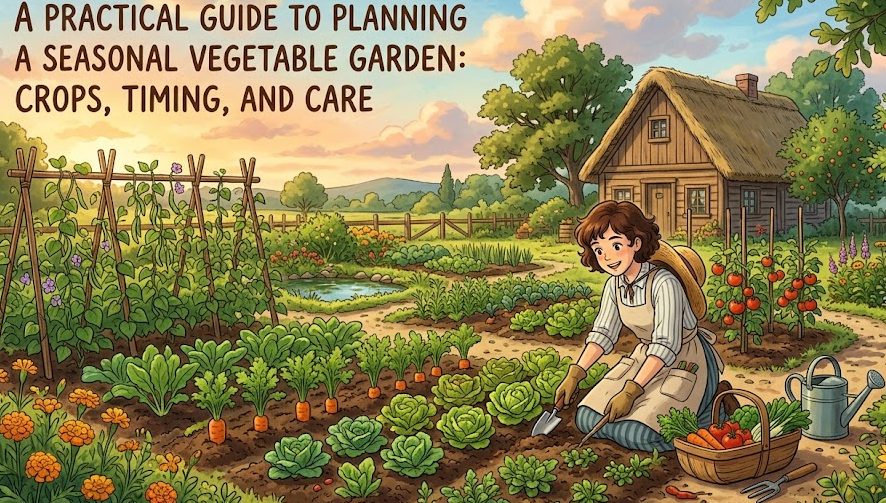
Growing vegetables successfully is not only about putting seeds into the soil and waiting for them to grow. A productive vegetable garden begins with planning. Choosing suitable crops, understanding seasonal conditions, preparing the soil, organizing planting dates, and providing regular care can make a significant difference throughout the growing period.
Every garden is different. Climate, soil type, available sunlight, rainfall, water access, and the amount of space available all influence which vegetables can be grown successfully. A crop that performs well in one location may struggle in another if temperatures or growing conditions are different.
Seasonal gardening makes it easier to work with these natural differences. Instead of trying to grow everything at the same time, gardeners can select vegetables according to the conditions expected during a particular part of the year.
With a simple plan and regular observation, even a modest garden can produce a useful variety of vegetables.
Begin With the Garden Space
Before choosing seeds or plants, take a close look at the available growing area.
Most vegetables perform best when they receive several hours of direct sunlight each day. Observe the garden during different parts of the day and identify areas that receive strong sunlight, partial shade, or very little light.
Also consider the location of water sources. A garden that is difficult to water may require more time and effort than expected.
The shape and size of the area matter as well. A long narrow garden can be divided into rows, while a smaller space may be better suited to raised beds or container gardening.
Avoid trying to use every available inch immediately. Leaving pathways between growing areas makes watering, weeding, harvesting, and maintenance much easier.
Understand Your Local Growing Season
Seasonal vegetable gardening depends heavily on local climate.
Some vegetables prefer cool conditions, while others grow best when temperatures are consistently warm. Understanding these differences is one of the most important parts of planning.
Cool-season crops generally tolerate lower temperatures better. Depending on the region, examples may include:
- Carrots
- Radishes
- Peas
- Lettuce
- Spinach
- Cabbage
- Broccoli
- Cauliflower
Warm-season vegetables generally prefer warmer soil and air. Common examples include:
- Tomatoes
- Cucumbers
- Beans
- Okra
- Eggplant
- Peppers
- Squash
These categories are broad rather than universal rules. Local climate can change the ideal planting period considerably.
Instead of following a calendar from another region exactly, gardeners should use local growing recommendations and observe actual seasonal conditions.
Make a Simple Crop List
It can be tempting to grow dozens of vegetables when planning a new garden.
However, a shorter crop list is often easier to manage.
Start by deciding which vegetables are actually useful for your household or farm. Consider which crops are commonly eaten and which ones are expensive or inconvenient to purchase regularly.
Then divide the list into categories.
For example, you might choose:
Leafy vegetables: spinach, lettuce, or similar greens.
Root vegetables: carrots, radishes, or beets.
Fruiting vegetables: tomatoes, peppers, cucumbers, and eggplant.
Legumes: beans and peas.
This simple organization makes it easier to plan space and planting dates.
Plan Around Temperature
Temperature is often more important than the name of the month.
A vegetable seed needs suitable conditions to germinate, and young plants may struggle if the weather is too cold or too hot.
Warm-season crops generally perform better after the soil has warmed sufficiently. Planting them too early can result in slow growth or poor establishment.
Cool-season vegetables can tolerate lower temperatures but may struggle when temperatures become excessively high.
This is why planting calendars should be treated as guidelines rather than fixed rules.
A good seasonal gardener watches temperature trends, soil conditions, rainfall, and local recommendations before planting.
Prepare the Soil Before Planting
Healthy soil provides the foundation for a productive vegetable garden.
Before planting, remove large weeds, clear unwanted debris, and loosen the soil if necessary. Avoid working extremely wet soil because it can become compacted and develop structural problems.
Adding suitable organic material can improve soil structure and contribute nutrients. Compost is commonly used in gardens because it adds organic matter while supporting the soil environment.
A soil test can also provide useful information about pH and nutrient levels.
Testing is particularly helpful when starting a new garden or when plants have repeatedly performed poorly.
The objective is to create soil that provides good root conditions, sufficient nutrients, and appropriate moisture without becoming excessively waterlogged.
Give Crops Enough Space
Plant spacing is easy to overlook.
Young seedlings may look small, but many vegetables become much larger as they mature.
Crowded plants can compete for sunlight, water, nutrients, and air movement. Dense growth may also make harvesting and maintenance more difficult.
Seed packets and reliable local growing guides usually provide spacing recommendations.
Follow those recommendations while considering the actual conditions in your garden.
If space is limited, choose compact varieties where available rather than planting everything closer together than recommended.
Use Succession Planting
One useful technique for extending the harvest is succession planting.
Instead of planting an entire crop at once, a gardener can plant smaller quantities at intervals.
For example, rather than sowing all the radish seeds on one day, a gardener might plant a portion and then repeat the process later.
This can spread harvesting across a longer period.
Succession planting works particularly well with vegetables that mature relatively quickly.
It can also prevent a common problem: having far more produce ready at one time than the household can reasonably use.
The exact interval depends on the crop, climate, and expected maturity period.
Consider Companion Planting Carefully
Some gardeners use companion planting by placing certain crops near one another.
The idea is based on the possibility that different plants may use space, nutrients, or sunlight differently. Some combinations may also make garden management easier.
However, companion planting should not be treated as a guaranteed method for controlling every pest or improving every crop.
Basic factors such as sunlight, spacing, irrigation, soil quality, and crop requirements remain more important.
Use companion planting as an additional planning technique rather than a replacement for fundamental garden care.
Water According to Plant Needs
Vegetable plants need consistent access to water, particularly during germination and early growth.
However, watering more does not always mean better growth.
Excessive watering can create poorly aerated soil and may contribute to root problems. Insufficient water can cause plants to wilt and reduce growth.
The right amount depends on crop type, soil, temperature, rainfall, plant size, and development stage.
Water the root zone rather than repeatedly wetting the entire plant whenever possible.
Morning watering can also be practical because it gives excess moisture on plant surfaces more time to dry during the day.
The most useful approach is to observe the soil and plants rather than following one rigid watering schedule.
Mulching Can Make Garden Care Easier
Mulch is a layer of material placed over the soil surface.
Organic materials such as straw, dry leaves, or suitable composted materials can be used depending on the gardening system.
A suitable mulch layer can help reduce evaporation, protect the soil surface, and suppress some weeds.
Mulch can also help keep soil temperatures more stable in certain conditions.
However, mulch should be used appropriately. It should not be piled directly against plant stems, and the material should be suitable for the garden.
As organic mulch breaks down, it can also contribute organic material to the soil.
Keep Weeds Under Control
Weeds compete with vegetable crops for water, nutrients, light, and growing space.
Controlling weeds is usually easier when they are still small.
Regular shallow cultivation, hand removal, mulching, and good garden spacing can all help.
Avoid disturbing the soil unnecessarily because repeated deep cultivation can bring additional weed seeds closer to the surface.
A garden that is checked regularly usually requires less intense weed removal than one that is left unattended for long periods.
Watch Plants Instead of Waiting for Problems
Regular observation is one of the simplest and most effective gardening habits.
Walk through the garden frequently and look at the leaves, stems, soil surface, and overall plant growth.
Changes can provide early clues.
For example, yellowing leaves may have several possible causes, including nutrient problems, watering issues, root stress, or natural aging. Wilting can result from insufficient water, excessive heat, root damage, or other conditions.
Do not assume that one visible symptom automatically identifies a specific problem.
Instead, look at the surrounding conditions and compare affected plants with healthy ones.
Early observation gives gardeners more time to investigate and respond.
Manage Garden Pests Responsibly
Vegetable gardens can attract insects and other organisms.
Not every insect is harmful. Some insects are beneficial because they pollinate flowers or feed on other pests.
Before using any pest-control product, identify the problem as accurately as possible.
Simple approaches such as removing severely affected leaves, using physical barriers, improving garden cleanliness, and encouraging beneficial insects may help with some problems.
If a pesticide is necessary, follow the product label carefully and use only products appropriate for the crop and intended purpose.
Avoid applying treatments simply because an insect is present. The presence of an insect does not automatically mean that the plant requires chemical control.
Support Taller Plants
Some vegetables require physical support as they grow.
Tomatoes, climbing beans, peas, and certain cucumber varieties may benefit from stakes, cages, trellises, or other structures.
Providing support early is often easier than trying to install it after plants become large.
Supporting plants can keep fruit away from the soil, improve airflow, and make harvesting more convenient.
The type of support should match the crop and its expected size.
Make sure structures are stable enough to handle the mature plant and any additional weight from fruit.
Think About Harvesting Before Planting
Harvest planning is often forgotten.
Different vegetables have different harvest windows. Some can be harvested gradually, while others are ready within a relatively short period.
Leafy vegetables can often be harvested in stages. Beans and cucumbers may require frequent picking once production begins. Root vegetables may remain underground for a longer period depending on the crop.
Understanding the expected harvest period helps gardeners plan how many plants to grow.
It also reduces waste.
If a household only needs a small quantity of a particular vegetable, planting several large rows may create unnecessary surplus.
Grow according to actual demand whenever possible.
Keep Notes From One Season to the Next
A garden journal can become one of the most useful planning tools.
Record when seeds were planted, when seedlings emerged, when harvesting began, which varieties performed well, and which problems appeared.
Also note unusual weather, irrigation difficulties, pest activity, and soil observations.
These records can make future planning much easier.
For example, if a particular variety repeatedly struggles during hot weather, you may choose a different variety or planting period next season.
Gardening becomes more efficient when each season provides information for the next one.
Plan for the Next Crop
Seasonal gardening does not necessarily end when one vegetable is harvested.
When one crop finishes, the space can potentially be prepared for another suitable crop.
This creates a continuous growing cycle.
For example, a cool-season crop may finish as temperatures rise, allowing the area to be prepared for a warm-season vegetable. Later, when temperatures decline again, another cool-season crop may be planted.
This approach can make better use of available garden space throughout the year.
However, avoid planting a new crop immediately if the soil requires preparation or if plant disease has affected the previous crop.
A Simple Seasonal Planning Framework
A practical garden plan can be organized into five stages:
1. Observe:
Understand sunlight, soil, available water, temperature, and space.
2. Choose:
Select vegetables that match the local growing conditions and household needs.
3. Prepare:
Improve the soil, organize beds, arrange irrigation, and gather necessary tools.
4. Grow:
Plant at appropriate times and provide regular water, nutrients, support, and maintenance.
5. Review:
Record what worked, what failed, and what should be changed during the next season.
This framework keeps the process manageable without making gardening unnecessarily complicated.
Common Planning Mistakes to Avoid
New gardeners often make similar mistakes.
Planting too many crops is one of them. A large garden can quickly become difficult to maintain.
Another mistake is ignoring sunlight. Vegetables that require strong sunlight may produce poorly in heavily shaded areas.
Overwatering is another common problem. Gardeners sometimes assume that more water will produce faster growth, but roots also need access to air.
Ignoring spacing can create crowded plants and make maintenance difficult.
Finally, planting without considering the season can result in weak growth or failed crops.
A little planning before planting can prevent many of these problems.
Final Thoughts
A successful seasonal vegetable garden is built through planning rather than guesswork.
Choosing crops that match local conditions, preparing the soil, understanding temperature patterns, providing appropriate spacing, managing water, controlling weeds, monitoring plants, and harvesting at the right time all contribute to better results.
There is no single perfect garden plan because growing conditions vary from one location to another. The best approach is to start with a manageable number of crops, observe how they perform, and use those experiences to improve future seasons.
Over time, a gardener develops a clearer understanding of which vegetables perform well, how quickly they grow, how much space they need, and which care practices are most effective.
Seasonal gardening is therefore more than a way to produce vegetables. It is an ongoing process of observation, adjustment, and learning—one growing season providing useful lessons for the next.