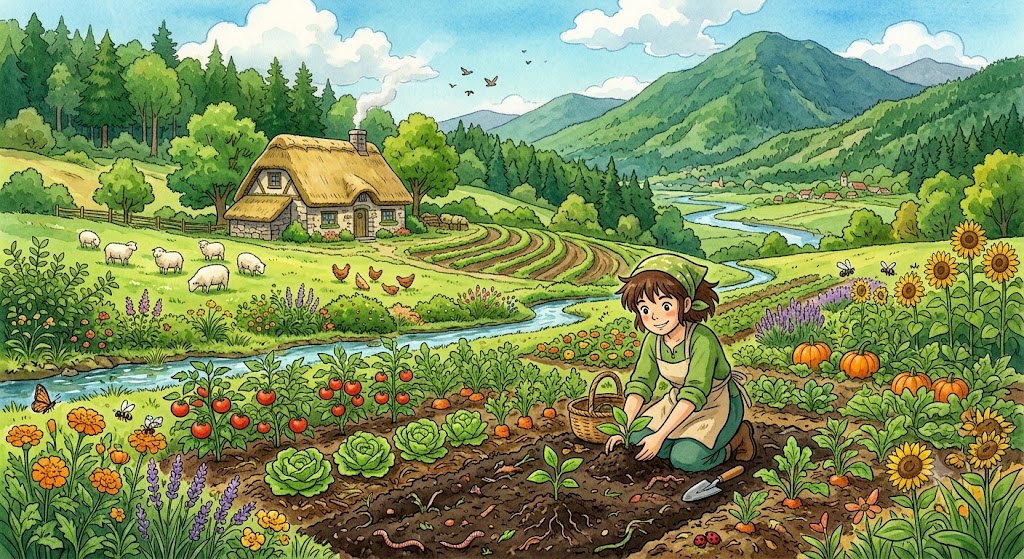
A productive farm is more than a place where crops are planted and harvested. Beneath every field is a living system made up of soil, roots, microorganisms, insects, water, plants, and countless natural processes. When these parts work together, the farm can become more productive and better prepared to handle everyday challenges.
For generations, farmers have learned that healthy land cannot be created overnight. Soil needs care, crops need suitable growing conditions, and natural resources need to be managed thoughtfully. Modern agriculture can build on this knowledge by using farming methods that work with natural processes rather than treating the surrounding ecosystem as something separate from production.
Nature-focused farming does not mean abandoning modern agriculture. It means making practical decisions that protect soil, encourage useful biodiversity, manage water responsibly, and maintain productive land for future seasons.
Think Beyond the Harvest
It is easy to judge a farm only by the amount of produce harvested.
A better question is: What condition is the farm left in after the harvest?
If a field produces a good crop but loses large amounts of topsoil, develops severe compaction, or becomes increasingly dependent on unnecessary inputs, the long-term result may not be positive.
Nature-focused farming looks at both short-term production and long-term land quality.
The aim is to create a system where farmers can continue producing useful crops while maintaining the natural resources that make agriculture possible.
Healthy Soil Is the Starting Point
Good farming begins beneath the plants.
Soil provides physical support for roots while also supplying water, nutrients, and an environment where microorganisms can live. Its structure influences how water moves through the ground and how easily roots can explore the soil.
Farmers can learn more about their soil through testing and regular observation.
Important factors may include:
- Soil pH
- Nutrient availability
- Organic matter
- Drainage
- Compaction
- Moisture conditions
- Signs of erosion
Understanding these characteristics allows farmers to make more informed decisions.
Rather than adding inputs automatically, management can be adjusted according to the actual condition of the field.
Keep the Soil Covered Whenever Practical
Bare soil is vulnerable.
Rain can break down exposed soil surfaces, while wind can carry away fine particles. Strong sunlight can also increase moisture loss from the surface.
Keeping soil covered through suitable crops, plant residues, mulch, or other appropriate methods can provide protection.
Cover crops are one option. Depending on the farming system, they can help protect the soil between primary crops while also contributing organic material when managed appropriately.
Mulching can provide another layer of protection and may help moderate soil temperature and reduce evaporation.
The best choice depends on the crop, climate, soil, and available resources.
Add Diversity Instead of Growing Everything the Same Way
A diverse farm can support a wider range of organisms.
Growing different crops, maintaining suitable vegetation around field boundaries, and incorporating flowering plants where practical can create additional habitats for beneficial insects and other organisms.
Crop diversity also provides agricultural benefits.
Different plants have different root systems, nutrient requirements, and growth patterns. Rotating crops can help break certain pest and disease cycles and prevent the repeated depletion of particular nutrients.
Diversity does not mean planting as many species as possible. It means creating a thoughtful combination that supports both farm production and ecological balance.
Use Crop Rotation as a Long-Term Tool
Growing the same crop repeatedly in the same location can create management challenges.
Certain pests and diseases may become easier to establish when their preferred host crop is continuously available.
Crop rotation changes the environment between growing seasons.
For example, farmers can rotate crops from different plant families or combine crops with different nutrient and root characteristics.
A well-designed rotation may also improve how land is used throughout the year.
The exact rotation should be based on local conditions and the needs of the farming operation rather than following a universal formula.
Encourage Beneficial Insects
A farm does not need to be completely free of insects to be healthy.
Some insects damage crops, but others help farmers by feeding on pests or supporting pollination.
Lady beetles, lacewings, bees, and many other organisms can have useful roles in agricultural environments.
Maintaining suitable flowering plants, hedges, and undisturbed habitat in appropriate locations can provide food and shelter for some beneficial species.
Farmers should learn to identify common insects before deciding whether they are a problem.
This simple habit can prevent unnecessary control measures and help preserve organisms that naturally contribute to the farm ecosystem.
Manage Water as Part of the Ecosystem
Water management affects much more than crop growth.
Excessive irrigation can waste water and energy, while poor drainage can create conditions that damage roots. Runoff can also carry soil and nutrients away from fields.
Farmers can improve water management by considering soil moisture, crop requirements, rainfall, and irrigation efficiency.
Drip irrigation may be suitable for certain crops because it delivers water close to the root zone.
Maintaining vegetation and soil cover can also help reduce erosion and improve how rainfall interacts with the soil.
The objective is to keep water available to crops while minimizing unnecessary losses.
Reduce Soil Disturbance When Appropriate
Soil can be disturbed by repeated cultivation, heavy machinery, and other field operations.
Some level of soil preparation may be necessary depending on the crop and production system, but unnecessary disturbance can affect soil structure and organisms living within it.
Reduced-tillage or conservation-oriented approaches may be appropriate in certain situations.
These systems can help maintain soil cover and reduce erosion, although they also require careful management and may create challenges involving weeds, residue, equipment, or disease.
There is no single tillage strategy that fits every farm.
The important principle is to avoid disturbing the soil more than necessary while still creating suitable conditions for the crop.
Use Organic Resources Responsibly
Agricultural operations often produce organic materials such as crop residues, leaves, manure, and other plant-based material.
When handled correctly, some of these resources can be incorporated into soil-management programs.
Compost and properly managed organic amendments may contribute organic matter and support soil structure.
However, organic does not automatically mean appropriate.
Materials should be suitable for agricultural use and managed properly to avoid contamination, nutrient imbalances, odors, or other problems.
Farmers should consider the nutrient content and application rate rather than assuming that more material will always improve the soil.
Create Space for Natural Predators
A productive ecosystem contains relationships between different organisms.
Birds, insects, amphibians, and other animals can sometimes contribute to natural pest management by feeding on agricultural pests.
Suitable habitat can encourage some of these organisms to remain near farming areas.
Hedges, trees, flowering plants, nesting structures, and other habitat features may be useful where appropriate.
However, farmers should consider local conditions. Some wildlife can also damage crops.
The goal is not to attract every possible species. It is to create a balanced environment where beneficial ecological relationships can develop.
Choose Crops That Suit the Environment
A crop that naturally fits local conditions may require fewer corrective measures than one grown outside its ideal environment.
Before planting, farmers can consider local temperature ranges, rainfall patterns, soil characteristics, available irrigation, growing-season length, and common pest pressures.
Selecting suitable varieties can also make a difference.
Some varieties may have characteristics that help them perform under particular environmental conditions or resist specific agricultural problems.
Local agricultural recommendations can be valuable when deciding which crops and varieties are appropriate.
Good crop selection is one of the simplest ways to reduce unnecessary pressure on a farming system.
Protect Farm Boundaries
The edges of a farm are often overlooked.
Field boundaries can provide important habitat for insects, birds, and other organisms. Vegetation along suitable boundaries may also help reduce wind exposure and provide additional protection against erosion.
However, unmanaged boundaries can also harbor weeds or pests.
The solution is thoughtful management rather than removing all vegetation.
Farmers can identify which areas provide useful ecological benefits and which areas need active control.
This creates a more intentional landscape rather than treating every non-crop plant as a problem.
Observe Before Making Changes
One of the most valuable nature-focused farming practices costs almost nothing: observation.
Walk through the field regularly.
Look at the soil after rainfall. Observe which areas dry quickly and which remain wet. Check whether insects are increasing. Notice where crops grow strongly and where they struggle.
Patterns often reveal problems that are not obvious from a distance.
A weak patch might be caused by poor drainage rather than fertilizer deficiency. Repeated pest activity might be connected to a particular planting pattern. Erosion may be occurring along one section of a field.
Observation helps farmers address the actual cause instead of automatically treating the visible symptom.
Combine Natural Practices With Modern Knowledge
Nature-focused agriculture does not require farmers to reject technology.
Modern tools can strengthen environmentally responsible farming when they are used appropriately.
Soil testing can provide information about nutrient conditions. Weather applications can improve irrigation planning. Moisture sensors can help monitor water availability. Satellite imagery can reveal differences in crop development across large fields.
These tools can complement ecological farming practices.
The best approach is often a combination of traditional observation, scientific information, and practical technology.
Build the Farm Step by Step
Farmers do not need to redesign their entire operation in one season.
A gradual approach is often more practical.
Start by identifying one problem.
If erosion is an issue, focus on soil cover.
If water is being wasted, examine irrigation efficiency.
If pest pressure is increasing, improve monitoring and habitat for beneficial organisms.
If soil quality is declining, investigate organic matter, compaction, crop rotation, and nutrient management.
Measure what happens after each change.
This makes it easier to determine which practices actually provide value under local conditions.
The Long-Term Goal: A Farm That Supports Itself Better
Nature-focused farming is ultimately about creating stronger relationships between agricultural production and the surrounding environment.
Healthy soil supports roots. Healthy plants provide food and habitat. Beneficial organisms can contribute to pest management and pollination. Vegetation can protect soil and influence water movement.
None of these systems operates independently.
When farmers protect one part of the ecosystem, they may also strengthen another part.
This does not mean natural systems will solve every agricultural problem. Farms still face drought, extreme weather, pests, diseases, market pressures, and economic challenges.
But a well-managed ecosystem can provide another layer of resilience.
Farming With the Future in Mind
The best agricultural land is not simply land that produces a good harvest today. It is land that remains capable of producing healthy crops in future seasons.
Protecting soil, managing water carefully, supporting biodiversity, rotating crops, maintaining suitable habitats, and using organic resources responsibly can contribute to that long-term objective.
Nature-focused farming is therefore not about following a rigid set of rules. It is about understanding how the different parts of a farm interact and making decisions that respect those relationships.
A farmer does not have to choose between productivity and environmental responsibility at every step. With careful planning, many practices can support both.
The most sustainable farming systems are built gradually through observation, experimentation, measurement, and learning. When farmers work with the natural strengths of their land while using modern knowledge where it provides value, they can create farms that are productive today and better prepared for tomorrow.