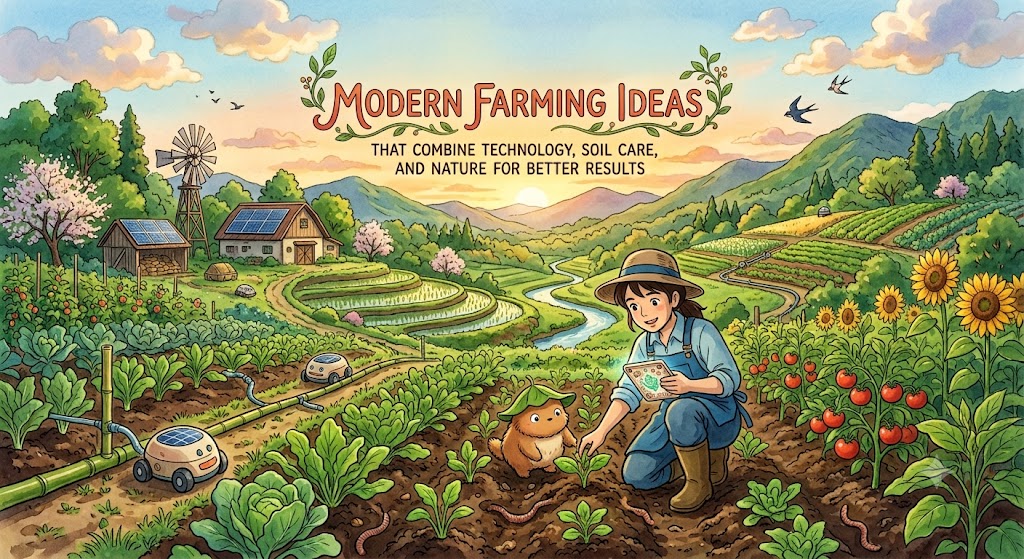
Modern agriculture is entering an interesting stage where technology and traditional farming knowledge are no longer separate worlds. Farmers can now use sensors, weather data, digital tools, improved irrigation systems, and precision equipment while continuing to rely on practices that have protected farmland for generations.
The most useful approach is not necessarily to choose between technology and nature. Instead, farmers can combine both.
A soil-moisture sensor can tell a farmer when conditions are becoming dry, while knowledge of the field explains why one area loses moisture faster than another. A weather forecast can help with planning, but practical experience can determine how that forecast may affect a particular crop. Compost, crop rotation, and ground cover can support soil quality, while digital records can help measure their results.
This combination creates a more complete approach to crop management—one that aims to improve production while using land, water, energy, and other resources responsibly.
Start With the Soil
Technology may receive most of the attention in modern agriculture, but productive farming still begins with the soil.
Plants need a suitable environment for their roots to develop. Soil structure, moisture, nutrients, pH, organic matter, and drainage can all influence crop performance.
Before introducing new technology, farmers should understand these basic conditions.
Soil testing can provide useful information about nutrient availability and pH. Regular observation can reveal compaction, erosion, drainage problems, or areas where crops consistently grow poorly.
This information creates a foundation for smarter decisions.
There is little value in using sophisticated equipment to monitor a field if the farmer does not understand what the collected information means.
Use Technology to Answer Practical Questions
The best agricultural technology solves a real problem.
Instead of asking, “What new farming device should I buy?” farmers can ask:
Where am I losing water?
Why is one part of the field producing less?
How can I monitor a large area more efficiently?
Which farm activities are costing the most time?
Can I reduce unnecessary fertilizer or fuel use?
Once the problem is identified, the appropriate technology becomes easier to choose.
For one farm, a basic irrigation timer may provide significant value. Another farm may benefit from soil sensors, satellite imagery, or precision machinery.
The most advanced technology is not automatically the most useful technology.
Smart Irrigation Can Connect Data With Soil Care
Water management is a perfect example of how technology and natural resource management can work together.
Traditional irrigation schedules may not account for changing weather or soil moisture. Smart irrigation systems can use timers, sensors, weather information, or other data to improve scheduling.
Soil-moisture monitoring can provide additional information about whether the root zone actually needs more water.
This does not mean irrigation should be completely automated without supervision.
Farmers should still inspect crops and soil because sensors can fail, readings can be inaccurate, and different crops have different water requirements.
A good system combines measurement with human judgment.
Protect the Soil With Ground Cover
Technology cannot replace the basic need to protect farmland.
Exposed soil can be vulnerable to erosion, moisture loss, and temperature fluctuations. Maintaining suitable ground cover can help protect the soil surface.
Depending on the farming system, this may involve crop residues, mulch, cover crops, or other suitable vegetation.
Cover crops can also contribute organic material and may provide additional benefits when appropriately selected and managed.
The correct approach depends on climate, soil type, crop rotation, water availability, and farm objectives.
The important principle is simple: healthy soil should be treated as a long-term agricultural asset, not just a surface on which crops are planted.
Make Crop Rotation Part of the Technology Strategy
Crop rotation is an established farming practice, but modern tools can make it easier to manage.
Digital farm records can track which crops were grown in particular fields and when they were planted. Over several seasons, this information can help farmers evaluate rotation patterns.
Different crops interact with soil and pests in different ways.
Rotating suitable crops can help diversify production and may interrupt some pest and disease cycles. It can also distribute nutrient demands across different crops.
When historical records are combined with field observations, farmers can design rotations based on actual farm performance rather than memory alone.
Use Sensors Without Forgetting the Field Walk
Sensors can measure things humans cannot easily observe continuously.
Depending on the equipment, sensors may monitor soil moisture, temperature, humidity, or other environmental conditions.
But data should not replace physical inspection.
A farmer walking through a field can notice broken irrigation lines, damaged leaves, unusual plant growth, pest activity, animal damage, or other issues that a sensor may not detect.
A useful routine is:
Sensor information → Field inspection → Interpretation → Action → Result tracking
This keeps technology in its proper role—as a tool that supports better decisions.
Give Beneficial Nature a Place on the Farm
A modern farm can still make room for natural ecosystems.
Beneficial insects, birds, soil organisms, flowering plants, trees, and other forms of biodiversity can contribute to agricultural environments.
For example, certain insects can prey on crop pests, while pollinators can support flowering crops.
Farmers can consider maintaining suitable vegetation around field boundaries or creating small habitat areas where practical.
This does not mean allowing unmanaged growth everywhere. Weeds and unwanted vegetation may still require control.
The objective is to create a balanced system where useful organisms have opportunities to survive without compromising crop production.
Combine Precision Farming With Responsible Input Use
Precision agriculture allows farmers to treat different parts of a field differently when there are meaningful differences in conditions.
GPS systems, field maps, sensors, satellite images, and variable-rate equipment can help identify areas that require different management.
For example, one part of a field may have different soil characteristics from another. Applying exactly the same amount of water or nutrients everywhere may not always be the most efficient strategy.
Precision methods can help farmers target resources more carefully.
However, the quality of the decision depends on the quality of the information. Poor data can result in poor application decisions.
Farmers should therefore verify maps, sensors, and recommendations before relying heavily on them.
Use Weather Data as a Planning Tool
Weather is one agricultural factor that technology cannot control but can help farmers prepare for.
Weather applications, local weather stations, and forecasting services can provide information that supports daily planning.
Farmers may use forecasts when considering:
- Irrigation
- Planting
- Harvesting
- Field preparation
- Equipment operation
- Crop protection
- Worker scheduling
Forecasts are not guarantees, so they should be combined with local observations.
A field may respond differently from another nearby field because of soil type, elevation, drainage, or crop stage.
Good weather management therefore combines broad forecasts with local knowledge.
Turn Farm Records Into Useful Information
A farm produces data every season, even when farmers do not formally record it.
Planting dates, input costs, irrigation activities, weather events, pest problems, harvest quantities, and selling prices can all become valuable information.
Digital record keeping makes this information easier to organize.
Over time, farmers can compare results between seasons.
For example, a farmer may discover that a certain variety consistently performs better under local conditions or that one field requires significantly more irrigation than another.
Records turn individual experiences into information that can guide future decisions.
Explore Technology Gradually
Technology can be expensive, and not every farm needs the same tools.
A gradual adoption strategy can reduce unnecessary spending.
Start with one area where improvement can be measured.
If water is the biggest concern, begin with irrigation monitoring.
If crop scouting consumes too much time, investigate digital mapping or aerial monitoring.
If fertilizer costs are increasing, start with soil testing and better nutrient records.
After implementing a change, compare the results.
Did water use decline?
Did labor time decrease?
Did crop quality improve?
Did the investment actually save money?
If the answer is no, the system may need adjustment or may simply not be suitable for that farm.
Build a Farm That Works With Nature
Modern farming does not have to mean removing natural processes from agriculture.
Instead, technology can help farmers understand those processes more clearly.
Sensors can reveal changes in soil moisture. Weather systems can provide environmental information. Satellite images can show differences across fields. Digital records can reveal patterns over several seasons.
At the same time, soil organic matter, crop diversity, natural habitats, beneficial organisms, and responsible water management can support the biological side of farming.
Together, these approaches create a more connected system.
The Three-Part Farming Model
A practical modern farm can be thought of as three connected layers.
1. Technology
Use sensors, weather information, digital records, precision equipment, and automation where they provide genuine value.
2. Soil Care
Protect soil structure, manage nutrients carefully, maintain suitable organic matter, reduce unnecessary compaction, and prevent erosion.
3. Nature
Encourage useful biodiversity, maintain appropriate habitats, diversify crops, and manage water and land with long-term health in mind.
None of these layers has to work alone.
Technology can measure what is happening. Soil care can strengthen the growing foundation. Natural systems can provide ecological support.
Measure Progress Instead of Assuming Success
A new farming method should be evaluated based on results.
Farmers can track a few practical indicators:
Input cost per crop
Water used
Labor hours
Harvest quantity
Crop quality
Post-harvest losses
Net return
The exact measurements will vary by farm.
The purpose is to determine whether a new practice is actually improving the operation.
A method that looks impressive but increases costs without improving results may not be worthwhile.
Better Farming Comes From Balance
The future of agriculture is unlikely to belong exclusively to either high technology or traditional farming.
The stronger opportunity lies in combining useful parts of both.
Farmers have generations of practical knowledge about soil, weather, crops, and local conditions. Modern technology provides new ways to measure, record, analyze, and manage those conditions.
When these strengths are combined, farmers can make more informed decisions without losing sight of the natural systems that support agriculture.
A Smarter Way Forward
Modern farming is ultimately about using resources intelligently.
A sensor is useful when it helps a farmer understand a field. Automation is valuable when it saves meaningful time or improves consistency. Precision equipment matters when it reduces unnecessary input use. Soil-management practices matter because productive land needs to remain healthy beyond a single harvest.
The most successful approach will vary from farm to farm.
Rather than adopting technology simply because it is new, farmers can identify their biggest challenges and select tools that address those challenges. At the same time, protecting soil, supporting biodiversity, managing water carefully, and maintaining crop diversity can strengthen the natural foundation of the operation.
The future of farming does not have to be technology versus nature.
It can be technology working alongside nature.
By combining reliable information, practical agricultural experience, healthy soil practices, and respect for natural systems, modern farms can work toward better productivity, more efficient resource use, and stronger long-term resilience.