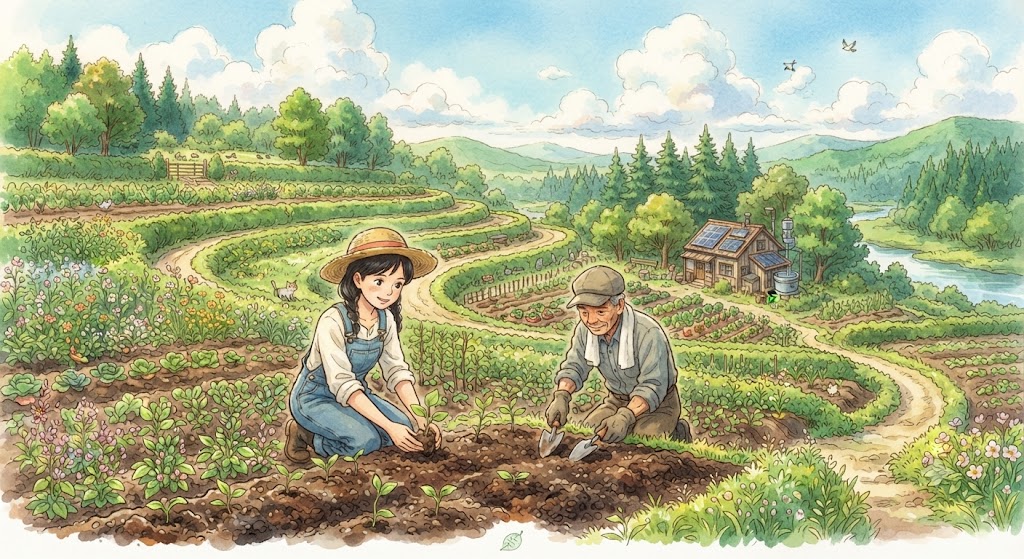
Healthy soil is one of the most valuable resources on any farm. It supports crops, stores water, cycles nutrients, and provides the foundation for productive agriculture. Yet soil can be difficult to protect when weather patterns become less predictable.
Periods of heavy rainfall can wash away valuable topsoil, while prolonged dry conditions can reduce soil moisture and make fields more vulnerable to erosion. Higher temperatures, intense storms, and changing growing seasons can also affect how soil behaves throughout the year.
For farmers in the United States and United Kingdom, protecting soil health does not necessarily require completely changing an existing farming system. In many cases, practical improvements—such as keeping soil covered, reducing unnecessary disturbance, improving drainage, and increasing organic matter—can make a meaningful difference over time.
The right approach depends on soil type, climate, crop rotation, farm size, and local conditions. However, several basic principles can help farmers build healthier and more resilient soils.
Why Soil Health Matters More as Conditions Change
Soil is much more than a material that holds plant roots.
A healthy agricultural soil contains minerals, organic matter, air, water, microorganisms, and other living organisms. Together, these components influence how well a field supports crops.
Good soil structure can help water enter the ground rather than immediately running across the surface. Organic matter can contribute to water-holding capacity and nutrient cycling. Strong root systems can help create channels through which water and air move.
When soil becomes compacted, depleted, or heavily eroded, these functions can be affected.
Climate variability makes this particularly important because farmers may experience a combination of conditions rather than one consistent pattern. A field could be excessively wet during one period and unusually dry several weeks later.
Building soil resilience can therefore help farms handle a wider range of conditions.
1. Keep the Soil Covered
One of the simplest principles of soil protection is to avoid leaving bare soil exposed for longer than necessary.
Bare ground is more vulnerable to wind and water erosion. During heavy rainfall, exposed soil particles can be displaced by runoff. During dry and windy conditions, loose soil can also become more susceptible to wind erosion.
Cover crops can provide a living cover between main cropping periods.
Depending on the farming system and local conditions, farmers may use crops such as:
- Rye
- Oats
- Barley
- Clover
- Vetch
- Radishes
- Other locally suitable cover crops
The best choice depends on the region, soil, planting window, and following crop.
In parts of the United States, cover crops are commonly considered as part of conservation-focused cropping systems. In the UK, cover crops and green manures can also be incorporated into rotations to keep soil covered and support soil structure.
The objective is not simply to grow another crop. It is to maintain living roots and surface protection when the primary crop is not occupying the field.
2. Reduce Unnecessary Soil Disturbance
Tillage can be useful for certain farming systems, but repeated or intensive soil disturbance can affect soil structure and organic matter.
Every farm has different requirements, so eliminating tillage completely is not necessarily practical or appropriate everywhere.
However, farmers can consider whether every tillage operation is necessary.
Reduced-tillage or no-till systems can leave more crop residue on the soil surface and reduce mechanical disturbance.
Less disturbance may also allow soil organisms and natural soil structure to develop more consistently over time.
The important point is to evaluate the entire production system rather than adopting a particular method simply because it is popular.
Soil type, drainage, weeds, available machinery, crop selection, and local weather all influence whether a reduced-tillage approach will work effectively.
3. Increase Organic Matter
Organic matter plays an important role in healthy agricultural soil.
It comes from decomposing plant and animal material and interacts with minerals, microorganisms, and water within the soil.
Adding organic material can be achieved through several approaches, depending on the farm.
Possible options include:
- Growing cover crops
- Returning suitable crop residues
- Using compost where appropriate
- Incorporating manure responsibly
- Maintaining diverse crop rotations
- Avoiding unnecessary removal of organic material
Organic matter should not be viewed as a quick solution. Building soil organic matter is generally a long-term process.
Farmers can monitor soil conditions over multiple seasons rather than expecting major changes after one application or one growing cycle.
4. Use Crop Rotations Strategically
Growing the same crop repeatedly can create particular challenges for soil and farm management.
Crop rotation introduces variety into the system.
Different crops have different root structures, nutrient requirements, residue characteristics, and effects on soil biology.
For example, including legumes in a rotation can provide nitrogen-related benefits depending on the crop and management system. Crops with deeper or different root systems can also interact with the soil differently from shallow-rooted crops.
A diversified rotation can also help farmers manage certain pests, diseases, weeds, and nutrient demands.
The ideal rotation will differ between an American corn-and-soybean operation, a UK arable farm, and a mixed livestock farm.
The key is to think beyond one growing season and consider how today’s crop affects the condition of the field several years from now.
5. Prevent Soil Compaction
Heavy machinery can put considerable pressure on agricultural soil.
When soil becomes compacted, the spaces between soil particles can be reduced. This can restrict air movement, interfere with root growth, and make it more difficult for water to move through the soil.
Compaction can be especially problematic when heavy machinery operates on wet ground.
One practical strategy is to avoid unnecessary field traffic when soil is particularly vulnerable.
Farmers can also consider planned traffic routes, controlled-traffic systems, appropriate tyre pressures, and machinery choices where these approaches fit the operation.
Compaction problems are not always obvious from the surface. A field may appear normal while deeper layers have been affected.
Regular observation and appropriate soil testing can help identify potential problems before they become more difficult to manage.
6. Manage Water More Carefully
Climate variability can create two opposite problems: too much water and too little.
Good soil management can help with both.
Soils with healthy structure and sufficient organic matter can often provide better conditions for water infiltration and storage. However, soil cannot compensate for every extreme weather event.
Drainage also matters.
In areas of the UK where heavy rainfall can leave fields saturated, effective drainage management can be an important part of maintaining workable soil.
In drier regions of the United States, maintaining soil moisture can become a greater concern.
Farmers can use soil-moisture measurements, weather information, field observations, and irrigation technology to make more informed water-management decisions.
Rather than asking only, “How much water does the crop need?” it can be useful to consider how efficiently the soil is storing and supplying that water.
7. Manage Crop Residues Instead of Automatically Removing Them
After harvest, crop residue can serve an important role.
Leaves, stems, roots, and other remaining plant material can protect the soil surface and eventually contribute organic material as they decompose.
Removing every piece of residue is not always necessary or beneficial.
Residue can reduce the impact of rainfall on exposed soil and provide some protection from wind.
However, residue management needs to be balanced with other farm requirements. Excessive residue can create challenges for planting or pest management in certain systems.
The right strategy depends on the crop, equipment, soil, climate, and following crop.
The goal is to manage residue intentionally rather than treating it simply as waste.
8. Create Vegetated Buffer Areas
Water moving across agricultural land can carry soil particles and nutrients with it.
Vegetated buffer strips can help slow runoff and trap sediment before it reaches waterways.
These areas may include grasses, shrubs, trees, or other suitable vegetation depending on their purpose and location.
Buffer areas can be particularly useful near streams, drainage channels, ponds, and other sensitive areas.
For farms in the US and UK, local environmental rules and agricultural guidance should be considered when planning buffers, especially near watercourses.
Even relatively small areas can have a useful role when they are positioned strategically.
9. Avoid Working Soil When It Is Too Wet
Soil moisture is important not only for crops but also for field operations.
Working very wet soil can increase the risk of compaction and structural damage.
This can be tempting to ignore when planting or harvesting windows are short, especially when weather conditions are unpredictable.
However, rushing onto a field under unsuitable conditions can create problems that remain long after the machinery has left.
Farmers can monitor soil moisture and field conditions before deciding whether machinery should enter.
Sometimes waiting for a suitable window can protect soil structure and reduce future management problems.
10. Test Soil Regularly
Good soil management should be based on information rather than assumptions.
Soil testing can provide useful information about factors such as nutrient availability and pH.
Regular testing allows farmers to track changes and make more informed decisions about fertiliser and other soil-management practices.
Testing is especially useful when combined with field observations.
A laboratory result may show nutrient levels, but farmers can also look for differences in crop growth, drainage, compaction, erosion, and soil structure.
Over time, these observations can create a more complete picture of how a field is changing.
Farmers should follow appropriate local testing guidance and interpret results according to the crops and soils involved.
11. Encourage Strong Root Systems
Healthy roots are an important part of healthy soil.
Roots create pathways through the soil and contribute organic material as they grow and decompose.
Different crops develop different root systems, which is another reason crop diversity can be valuable.
Cover crops can be particularly useful because they keep living roots in the soil during periods when the main cash crop is absent.
Deep-rooted plants may also access different parts of the soil profile, although their performance depends heavily on soil conditions.
The objective is to keep the soil biologically active rather than leaving it completely inactive between production periods whenever practical.
12. Use Fertiliser More Precisely
Fertiliser is an important agricultural input, but applying more does not automatically mean better crop performance.
Excess nutrients can create economic and environmental problems.
Soil testing, crop requirements, previous applications, yield information, and other farm data can help farmers make more targeted nutrient decisions.
Precision agriculture can take this further by applying different rates to different areas of a field.
Variable-rate technology can use field maps and other information to adjust applications according to specific conditions.
This approach can help farmers use inputs more efficiently while maintaining crop nutrition.
13. Use Livestock Carefully on Vulnerable Ground
For livestock farms, grazing management can have a significant effect on soil.
Animals can contribute nutrients through manure, but excessive grazing or repeated movement over wet ground can damage vegetation and compact soil.
Rotational grazing can help distribute grazing pressure more strategically.
Moving livestock between areas can give previously grazed sections time to recover.
The appropriate stocking level and rotation will depend on the land, weather, livestock type, forage availability, and farm objectives.
During particularly wet conditions, protecting vulnerable areas can become especially important.
14. Watch for Early Signs of Soil Problems
Soil degradation rarely needs to become severe before a farmer notices warning signs.
Useful things to watch for include:
- Increasing surface runoff
- Standing water
- Deep machinery tracks
- Poor crop establishment
- Reduced root development
- Visible erosion
- Crusting after rainfall
- Declining crop performance
- Increasing difficulty working the field
These signs do not always point to the same underlying problem.
For example, poor crop growth could be related to nutrients, drainage, compaction, pests, disease, weather, or several factors at once.
That is why observation should be combined with appropriate testing and professional agricultural advice when necessary.
Soil Protection Is a Long-Term Investment
One of the biggest mistakes in soil management is expecting immediate results from practices that are designed to produce long-term improvements.
A cover crop may protect the soil during one season, but building a more resilient soil system can take years.
Similarly, reducing compaction requires more than simply changing one machinery setting. It may involve changing traffic patterns, field timing, equipment, and overall management.
Farmers can therefore think of soil health as an ongoing investment rather than a one-time project.
Small improvements made consistently can become more significant over several growing seasons.
A Practical Starting Point for Farmers
Farmers who want to improve soil health do not necessarily need to change everything at once.
A practical starting process could look like this:
First, assess the current situation.
Identify areas affected by erosion, compaction, poor drainage, low organic matter, or inconsistent crop performance.
Next, choose one manageable improvement.
This might mean testing a cover crop on part of a field, reducing unnecessary tillage, changing machinery traffic patterns, or improving residue management.
Then, measure the results.
Record crop performance, soil observations, input use, and other relevant information.
Finally, expand what works.
If a practice performs well under the farm’s conditions, it can potentially be introduced to additional fields.
This approach reduces the pressure to make a complete transformation in a single season.
Building Resilient Soil for the Future
Climate conditions will continue to influence agriculture, but farmers have practical tools available to improve the resilience of their soils.
Keeping soil covered, maintaining organic matter, reducing unnecessary disturbance, preventing compaction, diversifying rotations, managing water carefully, and monitoring soil conditions can all contribute to a healthier production system.
There is no single soil-health strategy that works equally well on every farm. A practice that performs well on a dry American grain farm may need significant adjustment for a wetter farm in northern England.
The most useful approach is therefore to understand the soil, climate, crops, and farm system before choosing specific practices.
Healthy soil is built gradually. By treating soil as a long-term agricultural asset rather than simply a growing medium, farmers can create conditions that support productive crops while being better prepared for changing weather and challenging growing seasons.