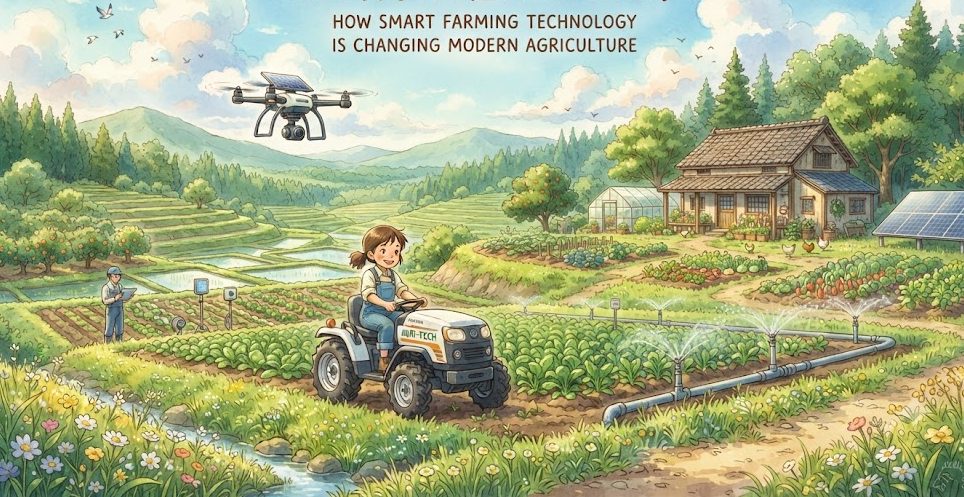
Agriculture has always depended on experience, timing, and a close understanding of the land. Today, technology is adding another powerful layer to that knowledge. From soil sensors and satellite imagery to automated machinery and farm management software, smart farming technology is changing how farmers make decisions and manage everyday operations.
For farms in the United States and United Kingdom, these technologies can be especially useful as producers face rising input costs, changing weather patterns, labour challenges, and growing pressure to use resources more efficiently.
Smart farming does not necessarily mean replacing farmers with machines. In many cases, it means giving farmers better information so they can make more informed decisions. A grower can use real-time soil data to decide when irrigation is needed, for example, while a livestock farmer can monitor animals remotely and identify unusual behaviour earlier.
The result is a more data-driven approach to agriculture—one where technology supports practical farming experience rather than trying to replace it.
What Is Smart Farming?
Smart farming is the use of digital technologies, connected equipment, sensors, data analysis, and automation to improve agricultural operations.
Traditional farming often relies on observations made during field visits and information collected manually. Smart farming adds continuous data collection and digital tools to that process.
A modern farm might use:
- Soil-moisture sensors
- Weather monitoring stations
- GPS-guided tractors
- Satellite and aerial imagery
- Agricultural drones
- Automated irrigation systems
- Livestock monitoring devices
- Farm management software
- Artificial intelligence and predictive analytics
- Connected machinery and Internet of Things (IoT) devices
These tools can work independently, but their real value often comes from combining information from several sources.
For example, a farmer could combine soil-moisture readings with weather forecasts and crop-development information. Instead of irrigating an entire field on a fixed schedule, the farmer may be able to make a more targeted decision.
Why Farmers Are Turning to Technology
Farming has always involved uncertainty. Weather, soil conditions, pests, diseases, commodity prices, labour availability, and equipment costs can all affect the final result.
At the same time, agricultural businesses need to operate efficiently.
In the US and UK, farms vary enormously in size and structure. A large grain operation in the American Midwest may have very different needs from a smaller mixed farm in England or Wales. Smart farming technology can be adapted to different operations rather than following one universal model.
One major reason for adoption is better resource management.
Fertiliser, water, fuel, feed, seed, and crop-protection products all represent significant expenses. If technology helps farmers identify where and when those resources are actually needed, it can potentially reduce unnecessary applications.
Technology can also save time. A farmer who can check field conditions or equipment alerts remotely does not necessarily need to inspect every location manually throughout the day.
Precision Agriculture and More Accurate Field Management
One of the most important parts of smart farming is precision agriculture.
Precision agriculture uses detailed information about specific areas of a farm rather than treating an entire field as if every part were identical.
A field can contain significant differences in soil type, moisture, elevation, nutrient levels, and crop performance. Traditional methods may apply the same treatment across the whole area, even when conditions vary.
Precision technology can help identify these differences.
GPS and mapping systems can create detailed field maps, while sensors and satellite imagery can provide information about crop conditions. Farmers can then use these insights to plan applications more carefully.
For example, a field may contain areas that consistently hold more water than others. Instead of applying exactly the same irrigation strategy everywhere, a farmer may use variable-rate equipment or adjust irrigation schedules according to local conditions.
This approach can make farm management more precise without requiring every decision to be made manually.
Sensors Bring Real-Time Information to the Farm
Sensors are becoming increasingly useful because they can collect information continuously.
Soil sensors, for example, can measure factors such as moisture and temperature. Weather stations can track conditions including rainfall, wind, and temperature.
That information can help farmers understand what is happening in a field without relying entirely on occasional inspections.
Imagine a vegetable grower who normally checks irrigation requirements in the morning. With connected soil sensors, the grower can receive updated information throughout the day.
If soil moisture falls below a chosen threshold, the system could provide an alert or, depending on the setup, trigger an automated irrigation response.
This does not eliminate the farmer’s role. Instead, it gives the farmer another source of information for deciding what action makes sense.
Drones and Satellite Imagery
Aerial technology is another important development in modern agriculture.
Drones can capture detailed images of fields, while satellite systems can provide regular observations over much larger areas.
These images can help farmers identify differences in crop growth, areas affected by water stress, drainage problems, or other unusual patterns.
A farmer does not necessarily need to walk through every part of a large field to notice that something has changed.
For example, if one section of a crop begins developing differently from surrounding areas, imagery may highlight the affected zone. The farmer can then investigate that specific area on the ground.
This combination of aerial information and physical inspection can make field scouting more targeted.
GPS-Guided Machinery Is Changing Fieldwork
Modern tractors and other agricultural machines increasingly use GPS and positioning technologies.
GPS guidance can help machinery follow planned routes accurately, reducing unnecessary overlap between passes.
This can be particularly valuable during activities such as planting, spraying, fertilising, and harvesting.
Automatic guidance systems can also reduce the physical workload for operators during long working days. Some systems can maintain a planned route while the operator monitors the equipment and surrounding conditions.
For large farms, even small improvements in field efficiency can become significant when multiplied across hundreds or thousands of acres.
The technology is also becoming relevant beyond traditional row-crop agriculture. Equipment guidance and digital mapping can support operations in orchards, vineyards, vegetable production, and other agricultural settings.
Artificial Intelligence in Agriculture
Artificial intelligence is another technology receiving increasing attention in farming.
AI systems can process large amounts of information and identify patterns that may be difficult to detect manually.
In agriculture, AI can be used for applications such as:
- Crop monitoring
- Yield estimation
- Weed identification
- Equipment diagnostics
- Weather-related analysis
- Livestock monitoring
- Farm planning
- Early detection of potential problems
Computer vision is one particularly interesting application.
Cameras mounted on equipment or positioned around a farm can capture images that software analyses for specific characteristics. In some situations, computer vision can distinguish crops from weeds or identify unusual conditions.
AI-based systems can also support predictive decision-making. Instead of simply showing what is happening now, a system may analyse historical and current information to estimate what could happen next.
However, AI should be treated as a decision-support tool rather than an infallible source of truth. Weather can change unexpectedly, sensors can fail, and agricultural conditions are highly variable.
Smart Irrigation Can Help Manage Water
Water management is an important issue for farmers in many parts of the world.
Smart irrigation systems can combine soil sensors, weather information, crop requirements, and automated controls to determine when irrigation should occur.
Rather than following a fixed timetable, irrigation can potentially respond to actual field conditions.
This can be particularly useful when rainfall is unpredictable. If meaningful rain is expected, an automated system may be able to adjust irrigation plans depending on its capabilities.
In the UK, where rainfall patterns can vary considerably throughout the year, technology can help farmers understand soil conditions more closely. In parts of the US where irrigation plays a major role in agricultural production, more precise water management can also be economically important.
The exact benefits depend on the crop, soil, climate, equipment, and management approach.
Technology Is Also Changing Livestock Farming
Smart farming is not limited to crops.
Livestock producers are increasingly using digital tools to monitor animals and farm conditions.
Wearable devices and sensors can collect information related to movement, activity, feeding patterns, location, or other measurable characteristics.
For example, unusual movement patterns may prompt a farmer to check an animal more closely.
Automated feeding systems can also help manage feed distribution, while environmental sensors can monitor conditions inside livestock buildings.
The objective is not simply automation. Continuous monitoring can give farmers more information between routine inspections.
For larger livestock operations, this can be particularly useful because manually observing every animal continuously is difficult.
Farm Management Software Connects Everything
One of the less visible but extremely important parts of smart farming is farm management software.
Modern agricultural businesses may generate large amounts of information from machinery, sensors, financial records, weather services, crop observations, and other sources.
Without a system for organising that information, having more data can actually create more work.
Farm management platforms can bring information together in one place.
A farmer might use software to track:
- Field activities
- Planting dates
- Input applications
- Equipment usage
- Harvest information
- Inventory
- Labour
- Costs
- Weather records
- Livestock information
Having historical records can also make future planning easier.
For example, a farmer may compare crop performance between different fields or review previous input use when planning a new season.
What About the Cost of Smart Farming?
One of the biggest barriers to agricultural technology is cost.
Advanced machinery, sensors, software subscriptions, drones, connectivity equipment, and automated systems can require substantial investment.
This is particularly important for smaller farms.
Not every operation needs a complete technology upgrade. In many cases, farmers can begin with a single tool that solves a specific problem.
A relatively simple soil-moisture monitoring system, for example, may be more practical than purchasing an entire automated irrigation network.
Farmers can evaluate whether a technology saves labour, reduces inputs, improves decision-making, or provides another measurable benefit before expanding its use.
This gradual approach can make technology adoption more manageable.
Connectivity Remains an Important Challenge
Smart farming depends heavily on connectivity.
A sensor that collects information but cannot reliably transmit it may have limited usefulness. This can become a challenge in rural areas where broadband or mobile coverage is inconsistent.
Connectivity is therefore an important part of agricultural technology infrastructure.
Cloud-based systems can also create concerns about data access and reliability. Farmers need to understand where their information is stored, who can access it, and what happens if a service becomes unavailable.
Data ownership and privacy are becoming increasingly important as farms become more digitally connected.
Will Smart Farming Replace Farmers?
Probably not in the simple way that some technology discussions suggest.
Agriculture involves unpredictable conditions and practical decisions that cannot always be reduced to a computer-generated recommendation.
Farmers still need to understand their land, crops, animals, machinery, markets, and local conditions.
Smart farming is better understood as an extension of the farmer’s capabilities.
A sensor can report soil moisture, but someone still needs to determine what that information means for the crop.
An AI system can identify a possible problem, but a farmer may need to inspect the field before deciding what action to take.
A GPS system can guide a tractor, but the operator remains responsible for monitoring the machine and working environment.
The most useful technologies are often those that combine automation with human judgement.
The Future of Smart Agriculture
The next stage of agricultural technology is likely to involve greater integration.
Instead of individual devices operating separately, more systems may communicate with each other.
A future farm could potentially connect weather data, soil sensors, machinery, crop imagery, irrigation equipment, and management software into a single digital environment.
This could allow farmers to see a more complete picture of their operations.
Robotics may also become increasingly relevant. Autonomous or semi-autonomous machines could assist with repetitive tasks such as monitoring, weeding, harvesting, or transporting materials, depending on the crop and operating environment.
However, adoption will depend on practical factors including cost, reliability, regulations, connectivity, and the availability of technical support.
A More Data-Driven Future for Agriculture
Smart farming is changing agriculture by making information available faster and at a much more detailed level.
From a small soil sensor to a sophisticated fleet of connected machines, technology can help farmers understand their operations in ways that were difficult to achieve in the past.
For farmers in the United States and United Kingdom, the biggest opportunity may not be adopting every new technology. It may be choosing the tools that solve real problems on their particular farms.
Better data can support better decisions. Automation can reduce repetitive work. Precision tools can help manage resources more carefully. And digital records can give farmers a clearer picture of what is working over time.
The future of agriculture is therefore unlikely to be simply about machines replacing traditional farming. Instead, it is likely to be about combining agricultural knowledge with increasingly capable digital tools.
As smart farming technology continues to develop, farms that use data thoughtfully and adopt technology according to their practical needs may have more options for managing the challenges of modern agriculture.