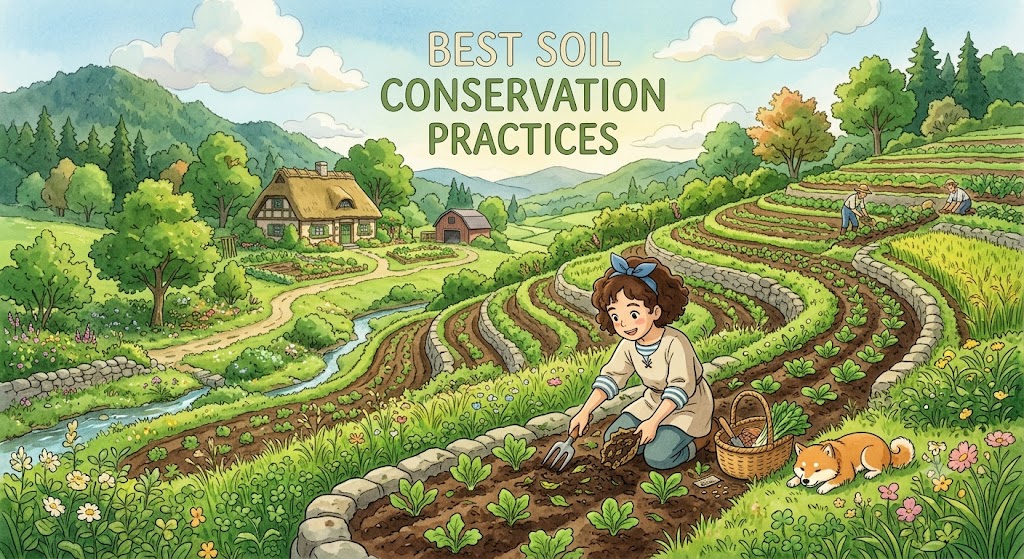
Soil is one of agriculture’s most valuable resources, yet it is often overlooked until productivity begins to decline. Every successful harvest depends on healthy, fertile soil that can store water, supply nutrients, support beneficial organisms, and provide a stable environment for plant roots. Unfortunately, soil erosion, nutrient depletion, excessive tillage, deforestation, and unsustainable farming practices are degrading millions of hectares of farmland every year.
Sustainable farming begins with protecting the soil. Soil conservation is not simply about preventing erosion—it is a long-term strategy that improves productivity, reduces farming costs, enhances environmental health, and ensures that future generations can continue producing food successfully.
This guide explores the most effective soil conservation practices that farmers can adopt to protect their land naturally while maintaining profitable and environmentally responsible farming systems.
What Is Soil Conservation?
Soil conservation is the practice of protecting soil from erosion, nutrient loss, compaction, and degradation while improving its long-term fertility and productivity.
Healthy soil supports:
- Strong root development
- Efficient water absorption
- Nutrient availability
- Beneficial microorganisms
- Higher crop yields
- Greater resilience against drought and extreme weather
Protecting soil today helps ensure consistent harvests for years to come.
Why Soil Conservation Is Essential for Sustainable Farming
Without proper conservation, soil gradually loses its ability to support healthy crops.
Common consequences of poor soil management include:
- Declining crop yields
- Increased fertilizer requirements
- Water runoff and flooding
- Loss of fertile topsoil
- Reduced biodiversity
- Higher production costs
- Poor water retention
By adopting conservation practices, farmers can improve both environmental sustainability and farm profitability.
Practice Conservation Tillage
Traditional deep plowing often disturbs soil structure and leaves fields vulnerable to erosion.
Conservation tillage minimizes soil disturbance while leaving crop residues on the soil surface.
Benefits include:
- Reduced erosion
- Better moisture retention
- Improved soil structure
- Increased organic matter
- Lower fuel and labor costs
Healthy soil organisms also thrive when the soil remains relatively undisturbed.
Keep the Soil Covered Throughout the Year
Bare soil is highly vulnerable to wind, heavy rainfall, and extreme temperatures.
Maintaining continuous ground cover protects the soil naturally.
Methods include:
- Cover crops
- Crop residues
- Organic mulch
- Living vegetation
Ground cover reduces runoff while preserving moisture and preventing nutrient loss.
Grow Cover Crops
Cover crops play a vital role in sustainable agriculture.
Popular options include:
- Clover
- Rye
- Mustard
- Cowpea
- Hairy vetch
- Oats
These crops improve soil by:
- Preventing erosion
- Fixing nitrogen
- Increasing organic matter
- Suppressing weeds
- Supporting beneficial insects
When incorporated into the soil, cover crops become valuable natural fertilizers.
Rotate Crops Regularly
Growing the same crop continuously weakens soil fertility and encourages pest populations.
Crop rotation restores balance by alternating crops with different nutrient requirements.
Advantages include:
- Improved nutrient cycling
- Reduced disease outbreaks
- Better weed management
- Enhanced soil structure
- Increased microbial diversity
Including legumes in the rotation naturally replenishes nitrogen levels.
Add Organic Matter Frequently
Organic matter is essential for maintaining fertile soil.
Excellent sources include:
- Compost
- Farmyard manure
- Green manure
- Crop residues
- Vermicompost
Organic materials improve:
- Soil fertility
- Moisture retention
- Soil aggregation
- Beneficial microbial activity
- Long-term productivity
Unlike synthetic fertilizers, organic matter continues enriching soil over time.
Prevent Soil Erosion with Contour Farming
On sloping land, rainwater often flows rapidly downhill, carrying away valuable topsoil.
Contour farming involves planting across the slope rather than up and down.
This technique:
- Slows water movement
- Reduces erosion
- Improves water infiltration
- Conserves nutrients
- Protects crop roots
Contour farming is particularly effective in hilly agricultural regions.
Build Terraces on Steep Slopes
Terracing transforms steep hillsides into level farming areas.
Benefits include:
- Reduced runoff
- Better water conservation
- Less soil erosion
- Improved crop management
- Increased land productivity
Although construction requires investment, terraces provide long-term protection for valuable farmland.
Apply Organic Mulch
Mulching offers multiple soil conservation benefits.
Natural mulch materials include:
- Straw
- Dry leaves
- Grass clippings
- Wood chips
- Crop residues
Mulch helps:
- Reduce evaporation
- Prevent weed growth
- Moderate soil temperature
- Improve soil organic matter
- Protect soil from heavy rainfall
As mulch decomposes, it further enriches the soil.
Improve Water Management
Poor irrigation practices often contribute to soil degradation.
Efficient water management protects both soil and crops.
Useful methods include:
- Drip irrigation
- Rainwater harvesting
- Laser land leveling
- Soil moisture monitoring
- Proper drainage systems
Balanced irrigation prevents both drought stress and waterlogging.
Establish Windbreaks
Strong winds can remove fertile topsoil, especially in dry regions.
Planting rows of trees or shrubs around fields reduces wind speed.
Windbreaks provide:
- Soil protection
- Reduced evaporation
- Improved biodiversity
- Habitat for beneficial wildlife
- Better microclimates for crops
They also contribute to long-term carbon storage.
Reduce Soil Compaction
Heavy machinery and repeated traffic compress soil, limiting root growth and water movement.
Farmers can reduce compaction by:
- Avoiding field work when soil is wet
- Using controlled traffic systems
- Planting deep-rooted crops
- Reducing unnecessary machinery passes
Healthy, loose soil allows roots to grow deeper and absorb nutrients more effectively.
Encourage Soil Biodiversity
Healthy soil contains countless living organisms that support plant growth.
Beneficial organisms include:
- Earthworms
- Fungi
- Bacteria
- Nematodes
- Insects
Farmers can encourage biodiversity by:
- Reducing excessive pesticide use
- Applying compost
- Rotating crops
- Maintaining organic matter
- Minimizing tillage
Living soil is far more productive than biologically depleted soil.
Integrate Trees into Farming Systems
Agroforestry combines trees with crop or livestock production.
Trees contribute to soil conservation by:
- Stabilizing soil with deep roots
- Preventing erosion
- Adding organic matter
- Improving biodiversity
- Reducing wind damage
- Enhancing water infiltration
Many tree species also provide fruit, timber, fuelwood, or fodder, creating additional income.
Monitor Soil Health Regularly
Successful soil conservation requires continuous observation.
Farmers should monitor:
- Soil texture
- Organic matter levels
- Earthworm activity
- Water infiltration
- Soil pH
- Crop performance
Regular soil testing helps identify nutrient deficiencies before they affect crop production.
Use Integrated Nutrient Management
Instead of depending entirely on chemical fertilizers, integrated nutrient management combines different nutrient sources.
A balanced system may include:
- Compost
- Animal manure
- Crop residues
- Biofertilizers
- Mineral fertilizers (used responsibly)
This approach improves nutrient efficiency while protecting long-term soil fertility.
Long-Term Benefits of Soil Conservation
Farmers who invest in soil conservation often experience long-lasting improvements.
Major benefits include:
- Higher crop yields
- Reduced erosion losses
- Better drought resistance
- Improved water-use efficiency
- Lower fertilizer requirements
- Greater biodiversity
- Reduced farming costs
- Increased farm resilience
Healthy soil becomes more productive with each passing season.
Common Mistakes That Damage Soil
Avoiding harmful practices is just as important as adopting good ones.
Common mistakes include:
- Excessive tillage
- Burning crop residues
- Overgrazing livestock
- Continuous monocropping
- Poor irrigation management
- Overusing chemical fertilizers
- Removing all crop residues from fields
Correcting these habits significantly improves long-term soil health.
Conclusion
Soil conservation is one of the most important investments farmers can make for the future of agriculture. Healthy soil supports stronger crops, conserves water, reduces production costs, and protects the environment. Practices such as conservation tillage, crop rotation, cover cropping, mulching, contour farming, organic matter application, efficient irrigation, and agroforestry work together to create productive and resilient farming systems.
Sustainable farming depends on treating soil as a living resource rather than simply a place to grow crops. Farmers who protect their soil today will enjoy healthier harvests, greater profitability, and stronger resilience against climate change and environmental challenges in the years ahead.
Frequently Asked Questions
1. What is soil conservation in agriculture?
Soil conservation refers to farming practices that protect soil from erosion, nutrient loss, degradation, and compaction while improving its long-term fertility and productivity.
2. Why is soil conservation important?
Healthy soil increases crop yields, improves water retention, reduces erosion, lowers farming costs, and supports sustainable agricultural production.
3. Which farming practice is most effective for preventing soil erosion?
A combination of cover cropping, contour farming, conservation tillage, mulching, and maintaining vegetation cover provides the best protection against soil erosion.
4. How do cover crops improve soil?
Cover crops reduce erosion, add organic matter, suppress weeds, improve soil structure, fix nitrogen, and support beneficial microorganisms.
5. Can sustainable soil management improve farm profitability?
Yes. Healthy soil reduces fertilizer and irrigation costs, increases crop productivity, improves resilience to drought and heavy rainfall, and supports consistent long-term farm income.